April 5, 2026
Fire-rated Drywall UAE: Everything that you need to know
Fire-rated drywall systems are a required part of building design across the UAE. They are not optional upgrades. Regulations set by authorities such as Dubai Municipality and Civil Defence require specific fire resistance ratings for walls in commercial buildings, residential towers, hotels, and other structures.
Understanding what these systems are, how they are tested, and what specifications matter will help you make informed decisions on your next project.
For a complete overview of all drywall systems used in UAE construction, read our Drywall Systems UAE — The Complete Contractor’s Guide.
What Is a Fire-Rated Drywall System?
A fire-rated drywall system is a partition wall assembly that has been tested to resist the spread of fire and smoke for a defined period of time. The rating is expressed in minutes or hours. Common ratings used in UAE construction are 30 minutes, 60 minutes, 90 minutes, and 120 minutes.
The system is not just about the board. It includes the type of gypsum board, the thickness and number of layers, the GI stud and track gauge and spacing, any insulation inside the cavity, and the way joints and edges are finished. All of these elements work together to achieve the rated performance.
Environmental conditions such as heat and humidity can also influence system performance, which is explained in our blog on Drywall Installation in UAE Climate: Heat, Humidity & Coastal Conditions.
The framing material also matters, and aluminium drywall profiles UAE are increasingly used in high-humidity environments.
How Fire Resistance Is Tested and Rated
Fire-rated wall systems are tested in laboratories under controlled conditions. The wall assembly is exposed to fire on one side while the other side is monitored for heat transfer, structural integrity, and the passage of flame or smoke.
The result of the test is a certificate that confirms the assembly achieved a specific fire resistance rating. It is important to note that the certificate applies to that exact assembly. Changing any component, such as using a thinner stud or fewer board layers, can void the rating.
Dubai Municipality Fire Wall Requirements
Dubai Municipality sets out fire safety requirements for buildings through its building regulations and by referencing Civil Defence standards. These requirements specify where fire-rated walls must be installed and what rating is needed in each location.
A Dubai Municipality fire wall is typically required between units in residential buildings, around stairwells and lift shafts, between car parks and occupied floors, in corridors that serve as escape routes, and around plant rooms and electrical risers.
The required rating in each of these locations depends on the building type, height, and use. For most commercial and residential towers in Dubai, a minimum of 60 minutes of fire resistance is standard for separating walls. Higher ratings are required for more critical fire compartment boundaries.
Project consultants and Civil Defence approval drawings will specify the exact requirements for each wall type on a given project. It is the responsibility of the main contractor and fit-out company to ensure the correct assembly is used and installed as specified.
Understanding the 60 Minute Fire-Rated Drywall in UAE Projects
The 60-minute fire-rated drywall in the UAE is one of the most frequently used assemblies in commercial construction. A typical 60-minute rated partition uses fire-rated gypsum board, which contains glass fibers and other additives that slow the transfer of heat compared to standard board.
A common assembly for a 60-minute rating includes a single layer of 15mm fire-rated gypsum board on each side of a 64mm or 70mm GI C stud frame, with studs spaced at 600mm centers. Some assemblies achieve the same rating with different combinations. The exact configuration must match a tested and certified assembly.
Fire-rated boards are available in 12.5mm and 15mm thicknesses. Thicker boards and additional layers increase the fire resistance rating, which is how 90-minute and 120-minute assemblies are achieved.
Fire-Resistant Wall Systems: Key Components
A fire-resistant wall system that UAE projects rely on is made up of several components, each playing a specific role in the overall performance.
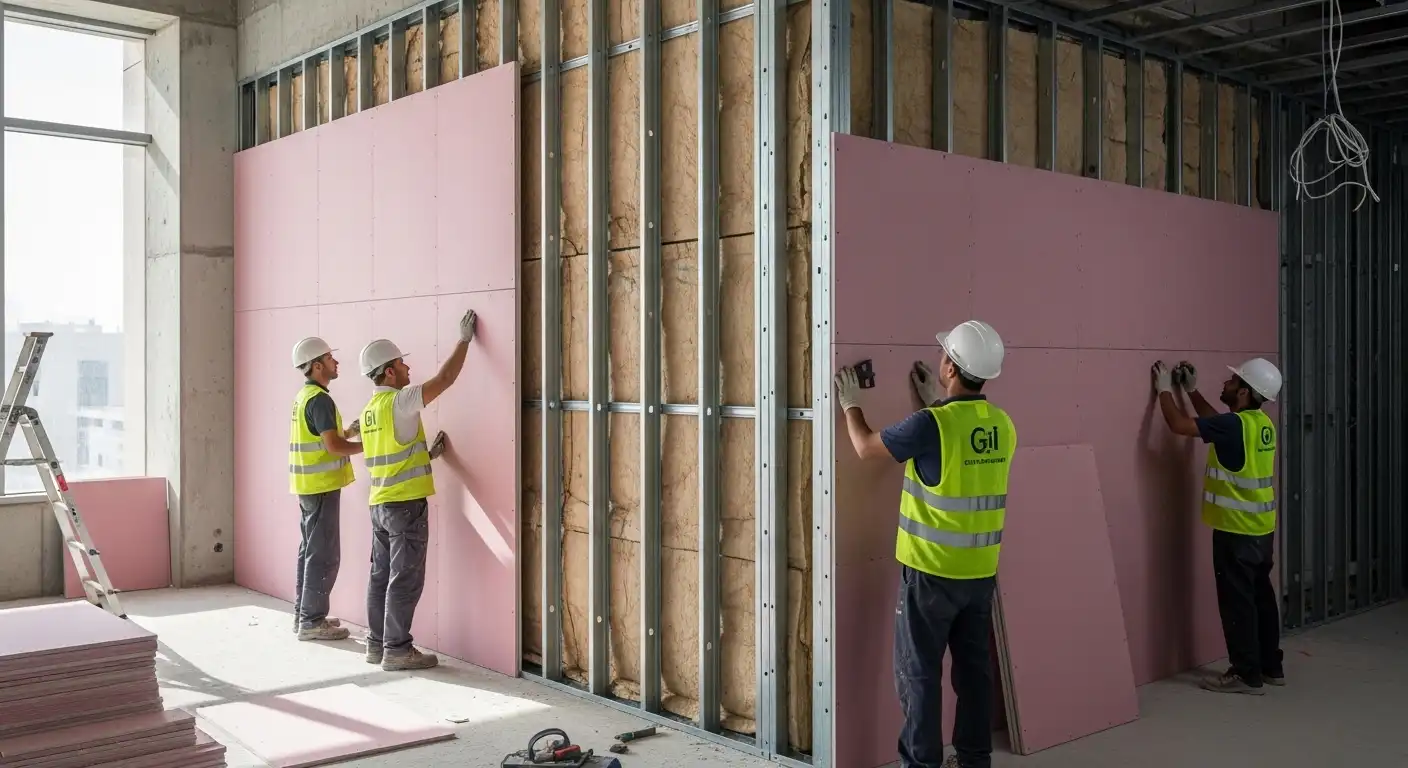
The gypsum board is the primary fire barrier. Fire-rated boards are denser than standard boards and are manufactured with additives that prevent rapid breakdown under heat. These boards are typically pink or red in color to distinguish them on site, though color coding varies by manufacturer.
he GI stud and track frame provide structural support, as explored in our guide on metal stud partition systems in the UAE. For fire-rated assemblies, the gauge of the metal is important. Thicker gauge steel holds its shape longer under heat, helping the wall stay in place and maintain its integrity during a fire.
Mineral wool or rockwool insulation is often placed inside the wall cavity. This material is non-combustible and adds to the thermal resistance of the assembly, helping to slow the transfer of heat from one side of the wall to the other.
Jointing compounds and tapes used at board joints must also be compatible with the fire-rated assembly. Gaps or poorly finished joints are weak points that can allow heat and smoke to pass through.
Common Mistakes That Compromise Fire Ratings
One of the most frequent problems on construction sites is using standard gypsum board in locations where fire-rated board has been specified. This is sometimes done to reduce cost or because the wrong material was ordered. The result is a wall that looks correct but does not perform as required.
Penetrations are another common issue. Any opening made in a fire-rated wall for pipes, cables, ducts, or other services must be properly sealed with fire-rated sealants or intumescent materials. An unsealed penetration can allow fire and smoke to travel through the wall just as easily as if the wall were not there.
Installation quality also affects performance. Studs that are spaced too far apart, boards that are not fully screwed, and joints that are not properly taped can all reduce the effective fire resistance of the assembly.
Compliance and Documentation on UAE Projects
On most commercial projects in the UAE, fire-rated wall assemblies must be supported by documentation. This includes the test certificate for the assembly, the product data sheets for the boards and other materials used, and, in some cases, a method statement showing how the system will be installed.
Civil Defence in Dubai and Abu Dhabi may request this documentation during inspection. Having it ready before work begins avoids delays and potential instructions to redo work that cannot be verified.
At GTI, we can supply fire-rated gypsum boards and GI framing that meet the specifications required for tested and certified assemblies. Our team can help you identify the right products for your project’s fire rating requirements.
Conclusion
Fire-rated drywall systems in the UAE are a compliance requirement backed by testing standards, municipal regulations, and Civil Defence approval processes. Knowing the difference between assemblies, understanding what a 60-minute rating actually means, and ensuring the right products are used and installed correctly are all part of delivering a building that meets its fire safety obligations.
In office environments, combining this with acoustic drywall systems UAE improves both safety and comfort.
If you are sourcing materials for a fire-rated partition wall in the UAE, GTI can help.
Contact us to discuss your project specifications, check product availability, and get support from a team that understands what UAE construction projects require.
Frequently Asked Questions
What does a fire-rated drywall UAE system actually protect against?
A fire-rated drywall system is designed to slow the spread of fire and smoke between spaces in a building. It gives occupants more time to evacuate and helps limit structural damage by containing fire within a defined compartment for the duration of its rated period.
Is a 60 min fire rated drywall sufficient for most UAE commercial projects?
For many standard applications, such as office partitions, corridor walls, and unit separations in residential buildings, a 60-minute rating meets the minimum requirement. However, some locations, such as stairwells, lift shafts, and plant rooms, may require 90-minute or 120-minute ratings depending on the building type and Civil Defence requirements.
What is the role of Dubai Municipality in firewall compliance?
Dubai Municipality sets the building regulations that define where fire-rated walls are required and what performance level they must meet. Civil Defence approves fire safety designs and inspects completed works. Both authorities are involved in ensuring that fire-resistant wall systems in Dubai meet the required standards.
Can I use standard gypsum board in a fire-rated partition wall in the UAE?
No. Standard gypsum board does not meet the requirements for a fire-rated assembly. Fire-rated gypsum board contains additives that slow heat transfer and maintain structural integrity longer under fire conditions. Using a standard board in a location that requires a fire rating is a compliance failure that can result in failed inspections and required rework.