August 02, 2026
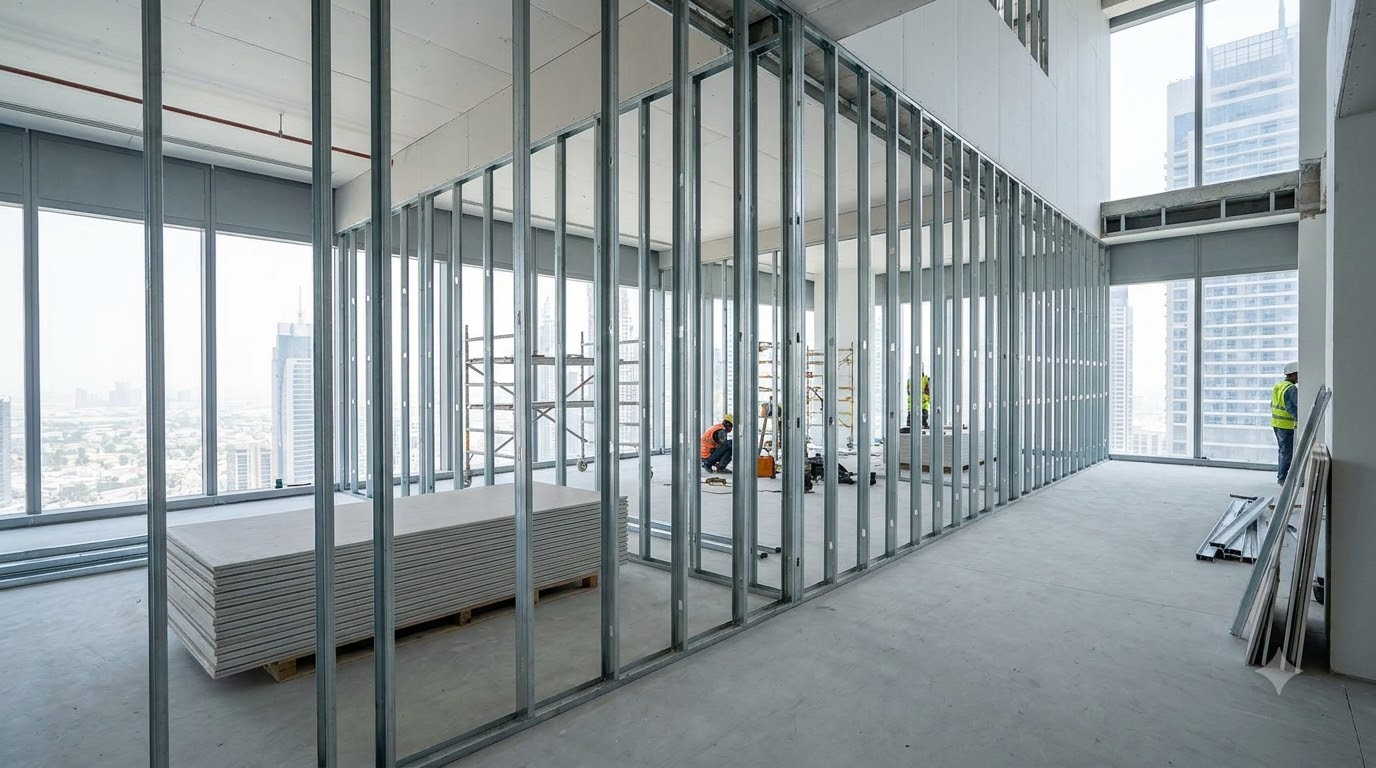
Most drywall partition specifications in the UAE are written for standard floor-to-ceiling heights. When the wall height goes to 4 metres, the calculation changes. A stud that performs well at 2.7 metres starts to behave differently at 4 metres. It deflects more under lateral load. It is more vulnerable to buckling.
And if the wrong size or gauge is specified, the finished wall will not be stable enough to meet the performance requirements of the project.
This guide covers what GI stud size to use for 4 metre high partition walls in the UAE, how the decision is made, and what else changes when the wall height increases.
Why Wall Height Changes the Stud Specification
A GI stud in a partition wall behaves like a vertical column that is fixed at the top and bottom by the track. When a lateral load is applied, whether from air pressure, accidental impact, or simply the stiffness requirement of the finished wall, the stud resists that load by bending. The taller the stud, the more it bends under the same load. This is a basic structural principle that directly affects stud selection.
At standard heights of 2.7 metres to 3 metres, a 70mm or 92mm GI C stud at standard gauge handles the lateral load requirements of most commercial partition walls without any special consideration. At 4 metres, the same stud in the same gauge will deflect beyond acceptable limits under the same load. The wall will feel unstable, gypsum board joints may crack over time, and the partition will not meet the deflection limits typically specified for commercial fit-outs in the UAE.
The solution is not simply to use the next size up. It involves a combination of stud width, steel gauge, and in some cases stud spacing that together bring the wall’s structural performance back within acceptable limits at the increased height.
Where tall partitions connect with suspended ceilings, Best Ceiling Tiles for Acoustic Performance in UAE Offices & Climate explains how ceiling tile selection affects office acoustics alongside structural framing decisions.
Standard GI Stud Sizes and What They Are Designed For
Before selecting a stud for a 4 metre high partition wall in the UAE, it helps to understand what the standard sizes are designed to handle.
The 48mm and 50mm GI C stud is the smallest profile used in UAE commercial construction. It is suitable for low-height, non-load-bearing partitions in standard office and residential fit-outs. At 4 metres, this profile is not appropriate regardless of gauge.
The 64mm and 70mm GI C stud is the most commonly used profile in UAE commercial drywall work. At standard heights up to around 3 metres, this stud at 0.5mm to 0.55mm base metal thickness performs well for most non-load-bearing interior partitions. At 4 metres, it needs a heavier gauge to maintain acceptable stiffness.
The 92mm GI C stud is a heavier profile used for taller walls, partitions requiring higher acoustic performance, or walls carrying additional loads from wall-mounted fixtures or services. At 4 metres, the 92mm stud at an appropriate gauge is the starting point for most UAE commercial partition specifications.
The 146mm GI C stud is used for the tallest and most heavily loaded partitions. At 4 metres, this profile provides significant structural reserve and is specified where the wall needs to carry substantial load or where the deflection limit is particularly tight.
What Size Should You Use for a 4 Metre High Partition Wall in the UAE
For most standard non-load-bearing partition walls at 4 metres in UAE commercial buildings, the 92mm GI C stud at a minimum base metal thickness of 0.7mm is the appropriate starting specification. This combination provides the stud depth and steel mass needed to resist lateral deflection at 4 metres without requiring unusually close stud spacing.
For high partition wall stud size decisions in UAE projects where the deflection limit is stricter than standard, where the wall carries wall-mounted fixtures, or where the partition forms part of a fire-rated or acoustic assembly that specifies a particular configuration, the 92mm stud at 0.8mm or above may be required. In some cases, a 146mm stud is the more appropriate choice.
Stud spacing also affects performance at 4 metres. Standard stud spacing in UAE commercial drywall work is 600mm centre to centre. Reducing spacing to 400mm centre to centre with the same stud profile increases the lateral stiffness of the wall and reduces deflection under load. This is sometimes a more practical solution than moving to the next stud size when the 92mm profile is already specified and only a marginal improvement in stiffness is needed.
The Role of Steel Gauge at 4 Metres
Stud width is only part of the specification. The base metal thickness, measured in millimetres, determines how much load the stud can carry before it deflects or buckles. At 4 metres, gauge selection becomes as important as profile width.
Standard commercial drywall in the UAE is typically specified with studs at 0.45mm to 0.55mm base metal thickness. At this gauge, performance at standard heights is adequate. At 4 metres, these gauges are generally not sufficient for a 92mm stud to meet standard deflection limits without reducing stud spacing significantly.
For 4m drywall stud specifications in UAE commercial projects, a base metal thickness of 0.7mm is the practical minimum for a 92mm stud at 600mm centres. At 0.8mm and above, the stud provides noticeably better performance and gives the wall a more solid feel that clients and end users notice in high-specification fit-outs.
Confirm the gauge specification with your structural engineer or the system manufacturer’s span tables before finalizing the order. Span tables provided by GI stud manufacturers give maximum wall heights for each combination of stud width, gauge, and spacing under defined lateral load conditions. These tables are the reference point for any high partition wall stud size decision in UAE construction.
Deflection Limits and Why They Matter
Deflection limits for partition walls define the maximum amount the wall is allowed to flex under lateral load before it is considered to have failed its performance requirement. In UAE commercial construction, the most commonly referenced deflection limit for non-load-bearing interior partitions is H/240, where H is the wall height. For a 4 metre wall, this means the maximum allowable deflection under the specified lateral load is approximately 16.7mm.
This limit exists to protect the gypsum board finish. Excessive deflection causes cracking at board joints and corners, particularly at door frames and partition intersections. It also affects the performance of fire-rated assemblies, which are tested at specific stiffness levels. A wall that deflects beyond the tested limits may not perform as the certificate states.
Specifying the right stud size and gauge for a 4 metre wall is fundamentally about meeting this deflection limit under the lateral load conditions that apply to the project. The stud size, gauge, and spacing combination needs to be confirmed against the deflection limit before installation begins.
Track Specification for 4 Metre High Walls
The track at the top and bottom of the partition also needs to be specified correctly for 4 metre walls. Standard track is typically the same width as the stud and at a similar gauge. For tall walls, the track gauge should match or exceed the stud gauge to ensure the fixing points at the top and bottom of the wall are as strong as the stud itself.
For floor tracks on 4 metre walls in UAE construction, fixing to the concrete slab using appropriate anchors at maximum 600mm centres is standard practice. For ceiling tracks, the fixing method depends on the slab type. In post-tensioned slabs, which are common in UAE high-rise construction, shot-fired fixings are generally not permitted, and chemical anchors or alternative fixing systems need to be confirmed with the structural engineer before work begins.
What Else Changes at 4 Metres
Beyond the stud specification, several other aspects of the partition assembly need to be reviewed when the wall height reaches 4 metres.
Board spanning capability needs to be confirmed. Standard 12.5mm and 15mm gypsum board can span between studs at 600mm centres at standard heights without issue. At 4 metres, the boards are longer and heavier, which increases the handling difficulty and the risk of board damage during installation. Horizontal board joints at mid-height may be required depending on standard board lengths available in the UAE market.
Door frame and opening details need to be designed for the increased height. Standard door frame sections used in UAE drywall partitions are not always rated for 4 metre wall heights. Reinforced or purpose-designed frame sections, or additional stud doubling around openings, are typically required.
Acoustic and fire performance of the assembly at 4 metres should also be reviewed against the tested configuration. Some tested assemblies have maximum height limits that fall below 4 metres, meaning a different or upgraded assembly may be needed to maintain the required rating at the increased height.
If the partition is being used for private offices, meeting rooms, or executive cabins, see our guide on how to soundproof office partition walls in UAE using drywall for practical techniques to achieve higher acoustic performance.
For more information on how fire and acoustic requirements affect drywall partitions in UAE projects, see our guide to Fire Safety & Acoustic Requirements for Ceiling and Partition Systems in UAE.
For the wider regulatory requirements that apply to interior partition systems, see UAE Building Code Requirements for Interior Partition Walls.
Conclusion
For most UAE commercial applications, a 92mm GI C stud at 0.7mm or 0.8mm base metal thickness at 600mm centres is the practical starting point, with the final specification confirmed from manufacturer span tables or structural engineering input.
GTI supplies GI studs and tracks in a full range of sizes and gauges for commercial drywall projects across the UAE. Contact us to discuss your project requirements.
Frequently Asked Questions
- What GI stud size should I use for a 4 metre high partition wall in the UAE?
A 92mm GI C stud at a minimum base metal thickness of 0.7mm at 600mm centres is the standard starting specification for 4 metre high partition walls in UAE commercial construction. - Can I use a 70mm GI stud for a 4 metre high drywall partition in the UAE?
A 70mm stud is generally not recommended for 4 metre high walls in the UAE without reducing stud spacing significantly, as it will not meet standard deflection limits at 600mm centres under typical lateral load conditions. - What base metal thickness is recommended for high partition wall studs in UAE projects?
For 4 metre high partition walls, a minimum base metal thickness of 0.7mm is recommended, with 0.8mm or above preferred for higher-specification UAE commercial fit-outs. - How does stud spacing affect performance at 4 metres in UAE drywall construction?
Reducing stud spacing from 600mm to 400mm centres increases lateral wall stiffness and reduces deflection, which can allow a smaller stud profile to meet the deflection limit at 4 metres. - What deflection limit applies to 4 metre high partition walls in UAE commercial buildings?
The most commonly referenced deflection limit for non-load-bearing partitions in UAE commercial construction is H/240, which equals approximately 16.7mm of maximum allowable deflection for a 4-metre wall. - Do I need a structural engineer to specify GI studs for 4 metre high walls in the UAE?
For standard commercial fit-outs, manufacturer span tables provide sufficient guidance, but structural engineering input is recommended for walls carrying significant loads, fire-rated assemblies, or projects where the deflection limit is specified by the consultant. - Does the track gauge need to change for 4 metre high partition walls in the UAE?
Yes, the track gauge should match or exceed the stud gauge for tall walls to ensure the fixing points at the top and bottom of the partition are as structurally capable as the stud itself. - Can standard gypsum board be used on 4 metre high GI stud partitions in the UAE?
Standard 12.5mm and 15mm gypsum board can be used, but horizontal board joints at mid-height may be required depending on standard board lengths available in the UAE market and handling constraints on site. - Are fire-rated partition assemblies tested for use at 4 metre heights in the UAE?
Some tested fire-rated assemblies have maximum height limits below 4 metres, so the test certificate for the specified assembly should be checked to confirm it covers the required wall height before installation begins. - Where can I source the right GI stud size for 4 metre high partition walls in the UAE?
GTI supplies GI studs and tracks in a full range of sizes and gauges across the UAE, and our team can advise on the correct specification for tall partition walls and confirm current stock availability.