November , 2026
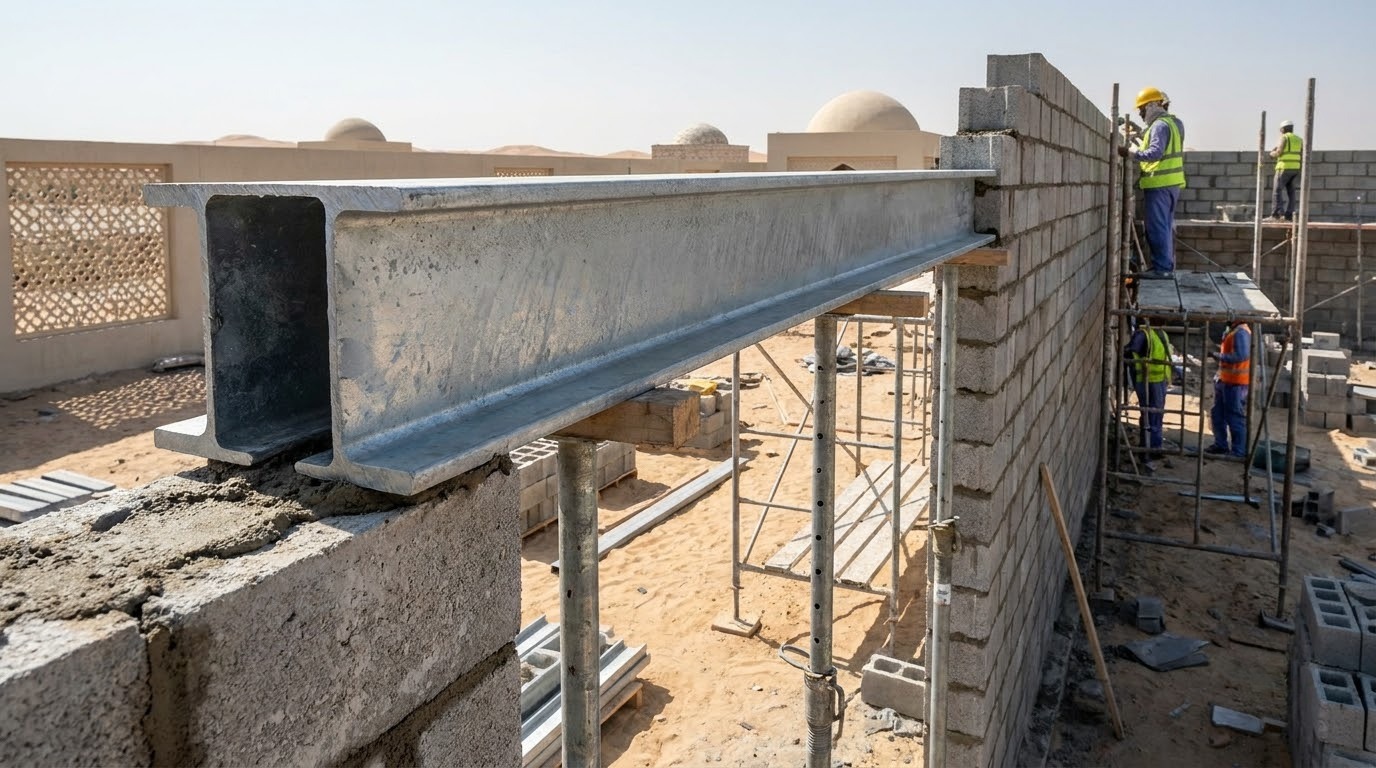
Most building codes allow steel angle lintels only for openings up to about 2.4 metres, according to the Brick Industry Association, and wider openings need heavier members. That limit is a good reminder that lintel size is never a guess. If you are asking what size steel channel lintel do I need in UAE projects, the answer depends on span, load, wall type, and climate. This guide explains how each factor affects the choice and how the lintel should be installed.
What a Steel Channel Lintel Does
A lintel is a horizontal member placed over a door, window, or other opening. It carries the weight of the wall above and passes that weight to the wall sections on either side. Without it, the blockwork above an opening can crack, sag, or fail.
A channel lintel uses a C- or U-shaped steel section. The shape gives good bending strength for its weight, and the open face is easy to fix, pack, or embed. Steel channel lintels in the UAE are common over service openings, doorways, shutters, and wide window openings in commercial and industrial buildings.
Factors That Decide the Size
Four factors set the lintel size. The first is the clear span, which is the width of the opening. A longer span bends the lintel more, so it needs a deeper or thicker section. The second is the load above the opening. This includes the wall itself, any floor or roof load that bears on it, and any point loads such as beams.
The third is the wall type. A solid block wall, a cavity wall, and a drywall partition all load a lintel differently. The fourth is the bearing length, which is how far the lintel rests on the wall at each end. A common starting point is at least 150mm of bearing on each side, but the engineer should confirm this for the actual load.
When planning openings in walls and ceilings, structural support is only one consideration. Buildings with fire-rated partitions must also maintain their fire protection around service openings. Choosing the correct [fire-rated or standard access panel in UAE] helps ensure maintenance access without compromising the intended fire separation.
Span and Load Capacity
Load capacity is not a single figure printed on a section. It changes with span, steel grade, thickness, and the way the load sits on the lintel. A channel that carries a block wall easily over a 1 metre opening may deflect too much over 2 metres.
Deflection matters as much as strength. A lintel can be strong enough not to fail and still bend enough to crack the plaster or blockwork above it. For that reason, the lintel is checked against both strength and allowable deflection. Load tables from the section supplier help at early stages, but the final size for any structural opening should come from a structural engineer.
Common Channel Sizes Available in the UAE
Channel sections are sold in standard sizes, and the ones most often stocked include 75x40mm, 100x50mm, 125x65mm, and 150x75mm. Thickness varies by supplier and by product, so two channels with the same nominal size can carry very different loads.
GI lintel sizes in UAE projects usually follow the same pattern, with galvanized channels or folded GI sections used for lighter openings. Lighter folded sections suit small openings with low loads. Heavier hot-rolled channels suit wider spans and heavier walls. When you request a quote, give the supplier the clear span, wall thickness, and load details so the right section is offered, rather than asking for a size alone.
Steel Grade and Coating for UAE Conditions
Coastal humidity, salt in the air, and moisture trapped in walls all attack steel. A lintel buried in a block wall is hard to inspect, so protection has to be right from the start. Rust also expands, and that expansion can crack the masonry around the lintel.
Galvanized channels are the safer choice for external walls, coastal sites, and damp areas. Check the coating weight and ask for the test certificate. For hot-rolled channels that are not galvanized, a proper protective coating system is needed, and any cut or drilled edge has to be treated on site. Confirm the steel grade on the mill certificate so it matches what the engineer specified.
Lintels Over Drywall Openings
Drywall partitions are lighter than block walls, so their openings are framed differently. A door opening usually has doubled studs on each side and a horizontal header made from track or channel above the frame. The header carries only the partition above it, which is a small load.
Even so, the header should be fixed securely to the studs and sized for the width of the opening. Wide openings or openings with heavy doors may need a heavier channel or extra bracing. If the partition is also fire-rated or acoustically rated, any change to the framing must stay within the tested assembly.
When planning service access within drywall partitions or ceilings, the opening size, framing support, and panel type should also be considered. Our guide on [how to choose the right access panel for ceilings and walls in UAE] explains the key factors involved.
How to Install a Steel Channel Lintel
Good installation depends on accurate preparation and careful placement. Follow these steps in order.
First, confirm the opening width and the lintel length against the drawing. The lintel should extend past the opening by the required bearing on each side. Second, prepare the bearing area. The blockwork under each end must be level, solid, and set in proper mortar. A bed of mortar or a bearing plate spreads the load.
Third, lift the lintel into position and check that it is level in both directions. A lintel that tilts will load the wall unevenly. Fourth, pack and fix the lintel as the design requires, using the correct anchors or cast-in fixings. Fifth, build the masonry above in the right sequence and allow the mortar to gain strength before adding heavy loads. Finally, protect the lintel from damage and repair any scratched galvanizing before it is covered.
Props may be needed under wide lintels until the wall above has cured. Do not remove them early.
Mistakes to Avoid
Several errors appear again and again on site, and each can be avoided with a little planning.
- Choosing a size by habit instead of by span and load
- Using too little bearing length at the ends
- Leaving cut or drilled galvanized edges untreated
- Installing the lintel out of level
- Loading the wall before the mortar has cured
Conclusion
Choosing the right lintel starts with the span and the load, then moves to section size, steel grade, and coating. Steel channel lintels perform well when they are sized by an engineer, protected against corrosion, and installed with proper bearing. Taking these steps early costs very little compared with repairing a cracked wall later.
If you are checking section sizes, galvanized options, or availability for an upcoming project, our team can help you review your requirements.
Share your opening sizes and wall details, and we will help you find suitable sections. Contact us
Frequently Asked Questions
- What size steel channel lintel do I need in UAE for a standard door opening?
The size depends on the span, wall type, and load above, so a structural engineer should confirm it rather than relying on a general rule. - What are the common steel channel sizes available in the UAE?
Commonly stocked sizes include 75x40mm, 100x50mm, 125x65mm, and 150x75mm, with thickness varying by supplier. - How much bearing does a steel lintel need on each side?
A common starting point is at least 150mm at each end, subject to the engineer’s calculation. - Is a galvanized lintel necessary in the UAE?
Galvanized lintels are strongly advised for external walls, coastal sites, and damp areas where steel can corrode. - Can I use a GI channel as a header over a drywall door opening?
Yes, a GI track or channel header is common over drywall openings when it is fixed to doubled studs and sized for the opening width. - Does lintel size depend on the wall above it?
Yes, the wall thickness, height, and any floor or roof load above all change the load the lintel must carry. - What happens if a lintel is too small?
It can sag, crack the masonry above, and in serious cases lead to wall failure. - How can I protect a cut galvanized lintel on site?
Clean the cut edge and apply a zinc-rich protective coating before the lintel is covered. - Do wide openings need props during installation?
Props are often used under wide lintels until the masonry above has gained enough strength. - Who should confirm the lintel size on a commercial project?
A structural engineer should confirm the size, grade, and bearing for any structural opening.