September , 2026
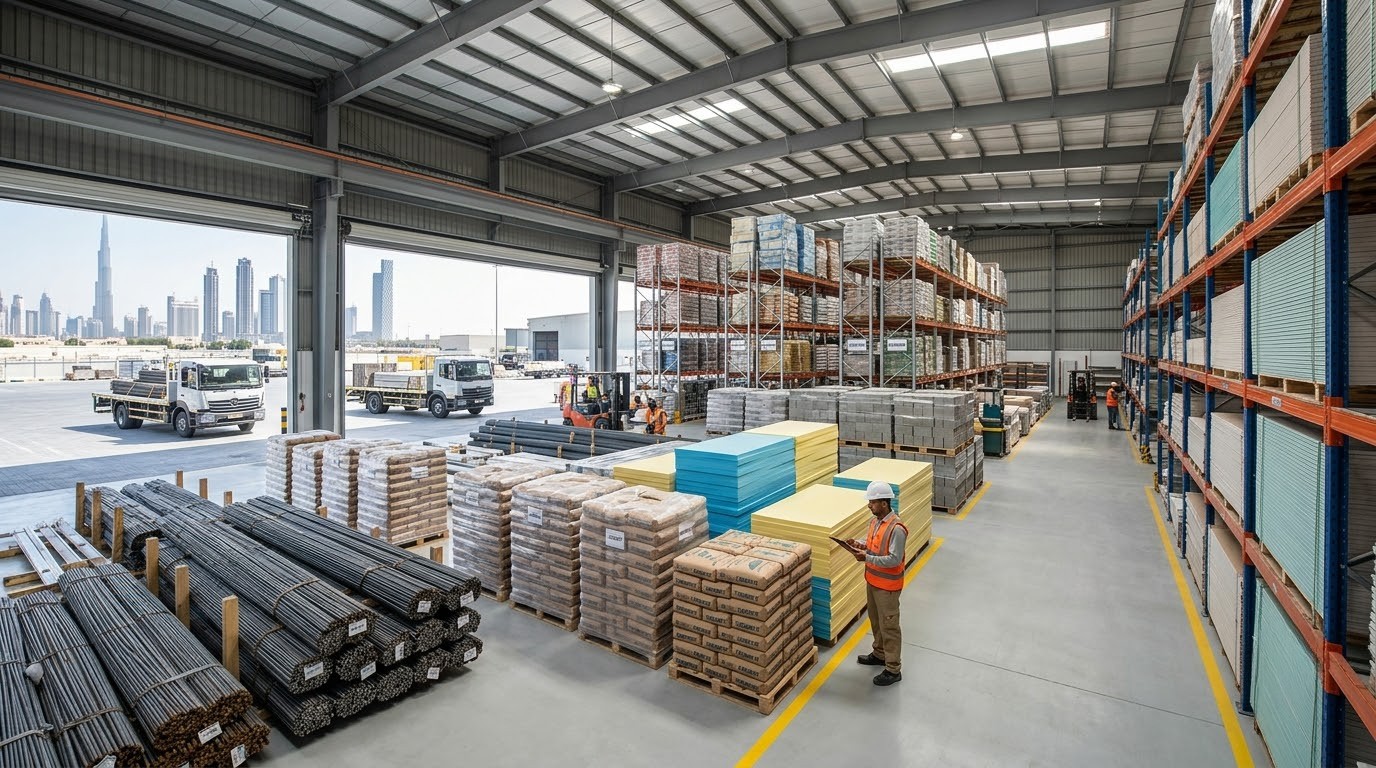
When there is no indication of a slowdown in a city, the acquisition of the appropriate materials may make or break a project. When it comes to large-scale residential properties and infrastructure projects, developers and contractors primarily source construction materials near me to save time, control costs, and avoid unnecessary delays and inconveniences caused by late deliveries. However, there are many suppliers in Dubai, and choosing an appropriate source is not straightforward. The quality of materials, certifications, availability, and delivery time are key factors in successful procurement. This guide explains the process for sourcing building materials in Dubai and outlines pitfalls that can lead to increased project costs, schedule slippage, and quality deterioration.
Dubai’s construction momentum continues to accelerate, backed by strong market fundamentals. The UAE construction market size will be USD 45,826.19 Million in 2025, and USD 69,022.54 Million in 2034, and its annual compound growth rate will be at 4.66 percent between 2026 and 2034.
At GTI, the acquisition of construction materials is designed to be easy, reliable, and effective for Dubai-based projects. It provides consulting services to contractors and developers across all construction phases. This simplifies and minimizes the risks in searching for efficient construction materials.
Understanding the Dubai Construction Materials Market
The Dubai building ecosystem is very varied, highly regulated, and competitive. The demand for certified materials has been rising in residential towers and infrastructure projects.
It is always useful to understand how the market functions and to distinguish reliable from unreliable suppliers before searching nationwide for construction materials near me.
This growth is strongly supported by the building materials sector itself. The market size of the UAE building materials is USD 6.75 billion as of 2024. In the future, IMARC Group projects the market size to be USD 11.44 billion in 2033 with a growth rate (CAGR) of 5% in the period of 2025-2033.
The sourcing strategy to be used must be oriented to:
UAE standards Regulatory compliance.
Availability of materials is regular.
Good logistical and delivery potential.
Why “Construction Materials Near Me” Matters in Dubai
Searching for construction materials near me is not just a convenience—it is a strategic decision.
Local suppliers help reduce:
Transportation costs
Delivery delays
Long supply chains result in risks.
Materials will be sourced locally, enhancing coordination and minimising project timelines. This is particularly true in Dubai, where punctuality is taken seriously, and no one can afford to be punished for being delayed.
Dubai’s rapid development further reinforces this need. The Dubai construction industry is undergoing an unprecedented boom with more than 30,000 building permits in the last year, supporting an annual phenomenal rise in the real estate and infrastructure environment of the emirate by 20 percent.
Building materials near me are also popular among contractors, as suppliers within a certain radius can respond to urgent / replacement orders much more quickly than companies in other areas, without affecting a site’s schedule.
Key Factors to Check Before Choosing a Supplier
Not all suppliers are equal. A quick search for construction materials near me may show many options, but quality varies.
Assess every supplier on the following parameters before selecting the final supplier:
Product Range and Availability
The Company offers a range of products and has many outlets, both domestic and international.
Certifications and Compliance
The supplier should be reliable and provide cement, steel, blocks, insulation, boards, and finishing materials. This will eliminate the need to liaise with various vendors.
Pricing Transparency
Inexpensive does not mean optimal. Value, not price, can be used to evaluate building materials near me.
Logistics and Delivery
The fast-paced nature of Dubai’s construction industry requires on-time delivery. The local inventory and effective logistics do count.
How GTI Simplifies Sourcing Construction Materials Near Me
GTI is based on a structured, project-focused approach that contractors can use when they need construction materials near me with the lowest risk.
GTI provides funding to projects by supplying:
- Large supply of accredited construction materials.
Good local supply chains.
Clear-cut pricing and technical support.
Dubai’s strategic logistics ecosystem makes such streamlined sourcing possible. Dubai has emerged as an important international center due to its robust logistics management and trade-friendly policies. Its developed road system, which connects the Jebel Ali Port and the Dubai World Central and Al Maktoum International Airport, facilitates easy trade and transport.
Using GTI to source results in reduced procurement complexity and a single point of contact for many material categories.
Common Construction Materials and Their Uses in Dubai
The table below highlights commonly sourced materials and their primary applications:
| Material Type | Common Use | Why It Matters in Dubai |
| Cement & Concrete | Structural works | Heat resistance and durability |
| Steel & Rebar | Framework & reinforcement | Strength and load-bearing |
| Insulation Boards | Walls & roofs | Thermal efficiency |
| Blocks & Bricks | Masonry | Speed and consistency |
| Finishing Materials | Interiors & exteriors | Aesthetic and longevity |
Digital Tools to Find Building Materials Near Me
Modern sourcing is heavily reliant on technology. Most professionals currently use a combination of online search and offline networks to find building materials near me.
Effective tools include:
- Live Supplier Websites.
- Google Maps of warehouse proximity.
- Direct talks with bulk suppliers.
Dubai’s position as a global trade gateway further strengthens supplier access. Dubai is a major re-export center in the Middle East, backed by a free trade policy, several free zones, and a world-standard infrastructure. In 2019, DP World managed 71 million TEUs around the globe, and Jebel Ali Port alone channeled 14.1 million TEUs.
Physical supplier capability and stock confirmation, however, should be used to validate
online search results.
Mistakes to Avoid When Sourcing Construction Materials Near Me
Even the professionals may commit sourcing errors. Common mistakes include:
- Selecting suppliers based on price.
- Disregard of material certifications.
- Ignoring the capacity to deliver.
Any failure to comply will affect costs and approval times, which are regulated in the Dubai market.
Why Local Sourcing Improves Project Efficiency
Search by local sourcing: building materials near me.
- Speed of procurement
- Cost predictability
- Quality control
The reason for the prevalence of large-scale projects that rely on existing suppliers, rather than fragmented sourcing, is this.
Finding construction materials near me in Dubai isn’t as simple as a search; it requires informed selection. Certified collaboration with suppliers, domestic availability, and the capacity to deliver goods to the required site will enable contractors to reduce time and costs.
GTI’s organized sourcing framework makes building materials readily accessible to developers building materials near me, while also ensuring quality and compliance. Selecting an adequate supplier is not only a procurement measure but also a strategic advantage in the competitive environment of the Dubai construction industry.
FAQ
- Why then should it make me in Dubai, find construction materials in my area?
Local sourcing will eliminate delivery time, logistics costs, and supply chain risks, which are crucial to fast construction operations in Dubai.
- What can I do to make sure that the construction materials in my locality are fine?
Certifications of suppliers of checks, documents, and references of project experience before completing purchases.
- Are building materials closer to imports less expensive?
In many cases, yes. The use of local materials helps reduce shipping costs, shorten lead times, and improve project efficiency.
- Is it a single supplier capable of dealing with construction materials of various types?
Yes. The available materials are a large quantity in suppliers who are well established, such as GTI, and hence acquisition and coordination are easily achieved.
- What is the biggest sourcing mistake with sourcing building materials: why not source my building materials close by?
The most frequent error is to choose based on price without reference to quality, compliance, and delivery ability.
Every ceiling and partition system installed in a UAE commercial building carries two obligations that cannot be traded off against each other. The first is fire safety. The second is acoustic performance.
Regulations govern the first. Occupant comfort and productivity depend on the second. In most commercial projects across Abu Dhabi and Dubai, both requirements apply simultaneously, and the materials and systems specified need to address both without compromise.
This guide covers what fire safety and acoustic requirements actually mean for ceiling and partition systems in the UAE, how they are measured and tested, what the regulations say, and how to specify systems that meet both sets of demands on the same project.
Why These Two Requirements Are Always Connected
Fire safety and acoustic performance are not separate specification exercises. They are linked at the level of the wall and ceiling assembly itself. A fire-rated partition that allows sound to travel freely between spaces is a compliance failure on one axis. An acoustically treated ceiling that has not been tested for fire resistance may fail Civil Defence inspection on another.
The materials that provide fire resistance, dense gypsum board, mineral wool insulation, heavy gauge GI framing, often also contribute to acoustic performance. The mass of a fire-rated wall assembly is part of what makes it resistant to both flame spread and sound transmission. Understanding this relationship means better specifications, fewer clashes between disciplines, and less rework on site.
Fire Safety Requirements for Ceiling Systems in UAE
The fire safety requirements for ceiling systems in the UAE are set by Civil Defence authorities in each emirate, with Dubai Civil Defence and Abu Dhabi Civil Defence being the two primary regulatory bodies for most commercial construction. These requirements reference international testing standards and specify where fire-rated assemblies are mandatory within a building.
Fire resistance for ceiling systems is expressed as a time rating. The assembly is tested in a laboratory by exposing one face to fire conditions while monitoring the opposite face for heat transfer, structural integrity, and the passage of flame or smoke. The rating, whether 30, 60, 90, or 120 minutes, represents how long the assembly maintains its performance under those conditions.
The most widely referenced test standards in UAE construction are BS 476 and ASTM E119. Some projects also reference EN 1364. The project’s Civil Defence approval drawings will specify which standard applies and what rating is required in each location.
Fire-rated ceiling assemblies are mandatory in escape corridors, stairwells, lift lobbies, plant rooms, and any ceiling above a fire-rated partition where continuity of the fire compartment needs to be maintained. The ceiling is part of the fire compartment boundary in these locations, not a separate finishing element.
A critical point that is often misunderstood on UAE projects is that a fire-rated ceiling assembly is a tested and certified system. The rating belongs to the complete assembly, including the specific grid profile, tile type and thickness, hanger spacing, and any insulation above. Changing any single component can invalidate the certification. This means specification decisions about grid and tile cannot be made independently of fire rating requirements.
Fire Rated Ceiling UAE Standards: What Compliance Actually Requires
Meeting fire-rated ceiling UAE standards requires more than selecting a product described as fire-resistant. It requires identifying the tested assembly that matches the project’s fire rating requirement, specifying every component of that assembly exactly as tested, and installing it in accordance with the manufacturer’s installation instructions and the test certificate.
The documentation required to demonstrate compliance typically includes the fire test certificate for the assembly, product data sheets for each component, and in many cases a method statement showing how the installation will be carried out. Civil Defence inspectors in Dubai and Abu Dhabi may request this documentation during inspection, and missing paperwork can result in instructions to replace work that cannot be verified as compliant.
For ceiling systems, the non-combustibility of the tile material is a baseline requirement in most commercial locations. Standard mineral fibre tiles and aluminium tiles are both non-combustible. However, non-combustibility alone does not constitute a fire-rated assembly. The full assembly, tested and certified to the required rating, is what compliance demands.
Partition Wall Fire Requirements in UAE Buildings
Partition walls in UAE commercial buildings are subject to fire performance requirements that vary by location and building type. The walls separating individual units in residential towers, corridors from occupied spaces, plant rooms from the rest of the building, and stairwells from floor plates all carry specific fire resistance ratings that must be achieved by the partition assembly.
The GI stud and track framing, the gypsum board type and number of layers, the insulation inside the cavity, and the way penetrations are sealed all contribute to the fire resistance of a partition wall. As with ceiling systems, the rating belongs to the complete tested assembly. A partition built with fire-rated board but using a lighter gauge stud than the tested assembly specifies may not achieve the stated rating.
Penetrations through fire-rated partitions are one of the most common compliance failures on UAE construction sites. Every opening made for a pipe, cable, duct, or other service must be sealed with a fire-rated sealant or intumescent material rated to match or exceed the partition’s fire rating. An unsealed penetration effectively removes the fire barrier at that point regardless of how well the rest of the wall is constructed.
For projects specifying partition walls for tall or heavily loaded applications, understanding the right GI stud size is essential to maintaining both structural integrity and fire rating compliance.
[Read our guide on what GI stud size to use for 4 metre high partition walls in UAE for detailed specification guidance on tall wall framing.]
Acoustic Performance Requirements for Ceiling Systems
Acoustic performance in ceiling systems is measured using the Noise Reduction Coefficient, or NRC. This scale runs from 0 to 1 and describes how much sound energy a surface absorbs rather than reflects into the space. A ceiling tile with an NRC of 0.70 absorbs 70 percent of the sound that reaches it.
The acoustic performance ceiling UAE commercial projects require varies by space type. Open-plan offices need NRC ratings of 0.70 or above to control ambient noise across large floor plates. Healthcare consultation rooms, classrooms, and spaces where speech privacy matters need higher ratings and may also require attention to ceiling attenuation class, which measures how much sound travels through the ceiling void between adjacent spaces.
Mineral fibre ceiling tiles are the standard acoustic solution for UAE commercial projects. They are available across a wide NRC range, compatible with standard T-grid systems, and cost-effective for large ceiling areas. High-performance acoustic tiles with NRC ratings above 0.80 are available for spaces with demanding acoustic targets.
For a full breakdown of which ceiling tiles deliver the best acoustic performance for UAE offices and the local climate, [see our dedicated guide on the best ceiling tiles for acoustic performance in UAE offices and climate.]
Acoustic Requirements for Partition Walls
Partition walls in commercial buildings need to control sound transmission between spaces as well as provide fire separation. The measure used for sound transmission through walls is the Sound Transmission Class, or STC. A higher STC rating means less sound passes through the partition.
Standard single-layer gypsum board partitions on GI stud framing achieve STC ratings in the range of 35 to 40, which is adequate for low-privacy applications such as open-plan dividers. For private offices, meeting rooms, and spaces where speech confidentiality is important, STC ratings of 45 to 55 are typically targeted. Achieving these higher ratings requires additional board layers, resilient channels to decouple the board from the stud, acoustic insulation in the cavity, and careful attention to flanking paths where sound bypasses the wall through the floor, ceiling, or adjacent structure.
If your project includes office partitions that need to achieve specific acoustic targets, the way the drywall system is detailed makes a significant difference to the result. [Our guide on how to soundproof office partition walls in the UAE using drywall covers the specific techniques and material combinations that achieve higher STC ratings in UAE commercial fit-outs.]
How Fire and Acoustic Requirements Interact in the Same Assembly
The relationship between fire performance and acoustic performance in wall and ceiling assemblies is generally complementary. The features that improve fire resistance tend to also improve acoustic performance, and vice versa.
Adding layers of gypsum board to a partition increases both its fire resistance and its sound transmission class. Filling the stud cavity with mineral wool insulation improves the thermal and acoustic performance of the assembly and also contributes to fire resistance because mineral wool is non-combustible and slows heat transfer through the wall. Using a heavier gauge stud keeps the wall more rigid, which benefits both structural performance under fire conditions and the transmission loss of the partition.
This means specifying a fire-rated partition assembly often provides a useful acoustic performance baseline without any additional design effort. The challenge is in the other direction: achieving high acoustic performance in a non-fire-rated location sometimes requires assembly configurations, such as decoupled resilient channel construction, that need to be carefully checked against fire rating requirements if the wall location later changes.
UAE Building Code and Civil Defence Compliance
UAE building regulations covering interior partition and ceiling fire performance draw from a combination of local Civil Defence requirements, Dubai Municipality and Abu Dhabi Department of Municipalities and Transport guidelines, and internationally referenced standards.
For commercial projects, Civil Defence approval is required before construction begins, and the fire performance specifications for walls and ceilings are reviewed as part of that process. Inspections during and after construction verify that the installed systems match the approved drawings. Deviations from approved specifications, even minor ones, can result in required remediation before a completion certificate is issued.
Understanding the full scope of UAE building code requirements for interior partition walls, including what is mandated, what is recommended, and where the regulations leave room for engineering judgment, is essential groundwork for any commercial project.
[Our guide on UAE building code requirements for interior partition walls covers the regulatory framework in detail and explains what compliance looks like in practice for different building types and partition locations.]
Specifying Systems That Meet Both Requirements
The practical starting point for specifying ceiling and partition systems that meet both fire safety and acoustic requirements in the UAE is to identify the fire rating requirement for each location first. Fire requirements are regulatory and non-negotiable. Once the fire-rated assembly is confirmed, the acoustic performance of that assembly can be assessed and supplemented if needed.
In most cases, a properly specified fire-rated partition or ceiling assembly will provide a reasonable acoustic baseline. If the acoustic target for the space exceeds what the fire-rated assembly delivers on its own, additional measures, such as acoustic insulation with a higher density, additional board layers, or resilient mounting details, can be incorporated while keeping the assembly within the tested and certified configuration.
Working with a supplier who understands both sets of requirements and can provide the right combination of products for each location is the most efficient way to move from specification to procurement without errors or omissions.
What to Have Ready Before Specifying
Before finalizing ceiling and partition specifications on a UAE commercial project, the following information should be confirmed. The Civil Defence-approved drawings showing fire rating requirements for each wall and ceiling zone. The acoustic performance targets for each space type, either from an acoustic consultant or from building type guidelines. The structural slab details, including whether the slab is post-tensioned, which affects the hanger fixing method for ceilings. The MEP coordination drawings showing service locations above ceilings and penetrations through partitions. And the lead times and local availability of the specified products, particularly for fire-rated assemblies and high-performance acoustic tiles that may not be standard stock items.
Having this information before products are specified prevents the common situation where a system is selected, procurement begins, and a Civil Defence comment or a coordination clash forces a specification change after materials are already on order.
Conclusion
Fire safety and acoustic performance are the two non-negotiable technical requirements for ceiling and partition systems in UAE commercial buildings. They are set by different authorities and measured by different standards, but they are addressed by the same materials, the same assemblies, and the same installation decisions. Getting both right from the start of the specification process is straightforward when you understand what each requirement demands and how the two sets of criteria interact in a real assembly.
GTI supplies fire-rated gypsum boards, acoustic ceiling tiles, mineral fibre systems, GI and aluminium drywall profiles, and all associated framing components for commercial projects across the UAE.
Whether you are specifying a complete ceiling and partition package or sourcing specific products to meet a Civil Defence or acoustic requirement, our team can help you identify the right products and confirm availability for your project timeline.
Contact us to discuss your requirements.
Frequently Asked Questions
- What are the fire safety requirements for ceiling systems in UAE commercial buildings? Civil Defence authorities in Dubai and Abu Dhabi require fire-rated ceiling assemblies in escape corridors, stairwells, lift lobbies, plant rooms, and anywhere the ceiling forms part of a fire compartment boundary.
- What test standards are used for fire-rated ceiling UAE compliance? The most commonly referenced standards for fire-rated ceiling systems in UAE projects are BS 476, ASTM E119, and EN 1364, with the applicable standard specified in the Civil Defence approval drawings.
- What NRC rating should ceiling tiles have to meet acoustic performance requirements in UAE offices? Open-plan offices in the UAE generally require ceiling tiles with an NRC rating of 0.70 or above, with higher ratings recommended for spaces where speech privacy or noise reduction is a priority.
- Can the same partition assembly meet both fire and acoustic requirements in a UAE building? Yes, fire-rated partition assemblies typically provide a useful acoustic performance baseline because the features that improve fire resistance, such as additional board layers and mineral wool insulation, also improve sound transmission class.
- What happens if a penetration through a fire-rated partition is not sealed on a UAE project? An unsealed penetration through a fire-rated partition removes the fire barrier at that point and constitutes a compliance failure that will need to be rectified before a completion certificate can be issued.
- Who is responsible for ensuring ceiling and partition fire ratings are met on UAE construction projects? The main contractor and fit-out company are responsible for ensuring the correct assemblies are installed as specified, with documentation available for Civil Defence inspection.
- Does mineral wool insulation inside a partition cavity improve both fire and acoustic performance in UAE buildings? Yes, mineral wool is non-combustible and slows heat transfer, which contributes to fire resistance, while also absorbing sound within the cavity, which improves the acoustic performance of the partition.
- Are aluminium ceiling tiles compliant with fire safety requirements for UAE commercial buildings? Aluminium ceiling tiles are non-combustible, but compliance with fire safety requirements depends on the complete tested and certified assembly rather than the tile material alone.
- How does ceiling attenuation class affect acoustic performance in UAE open-plan offices? Ceiling attenuation class measures how much sound travels through the ceiling void between adjacent spaces, which is particularly important in open-plan UAE offices where partial-height partitions are used and sound travels over partition tops.
- What documentation is needed to prove fire rating compliance for ceiling and partition systems on UAE projects? The required documentation typically includes the fire test certificate for the assembly, product data sheets for all components, and a method statement showing how the system was installed in accordance with the tested configuration.