October , 2026
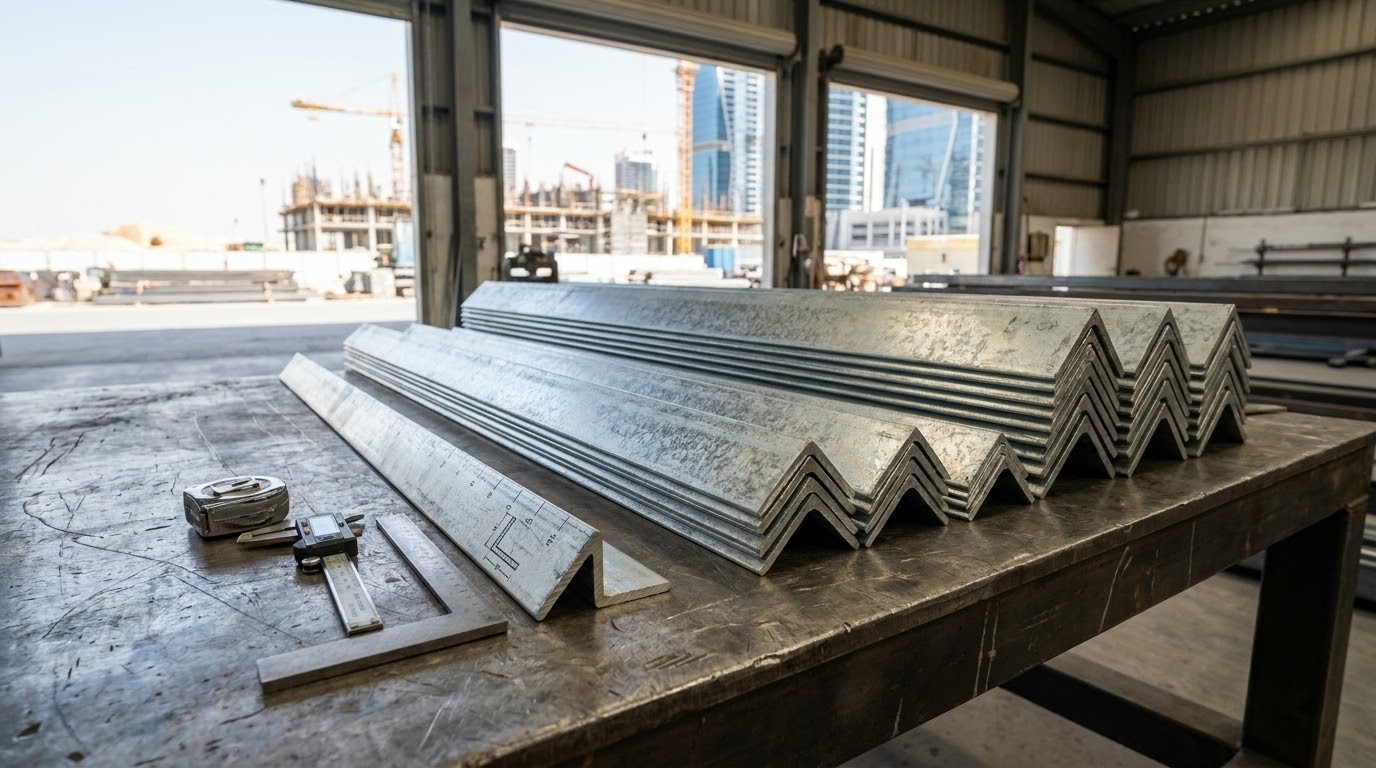
GI angle is one of the most consistently used steel sections in UAE construction. It appears in ceiling framing, partition wall details, door frame reinforcement, and structural support channels across commercial and residential projects. Despite how common it is, the specification decision is often made without a clear understanding of what the available sizes are, what standards govern the product, and which size suits which application.
This guide covers GI angle specifications in the UAE, including standard sizes, steel grades, galvanization standards, and the applications each size is best suited for.
What GI Angle Is and How It Is Made
GI angle is an L-shaped steel section produced by rolling or forming mild steel into an angle profile, then applying a zinc coating through a galvanization process. The zinc coating is what the G and I stand for: galvanized iron, though the base material in modern production is mild steel rather than iron.
The section is produced in continuous lengths, typically 6 meters, which is the standard bar length in the UAE construction market. It is then cut to length, cleaned, and either hot-dip galvanized or electro-galvanized depending on the product specification and end use.
The zinc coating makes the section suitable for UAE construction conditions. Without it, bare mild steel in coastal UAE locations would begin to show surface rust within weeks.
Equal vs Unequal GI Angle
GI angle sections fall into two categories based on the relationship between the two flanges.
Equal angle sections have both flanges at the same width. When viewed end-on, both legs of the L are identical. Equal angle is the more commonly used profile in UAE ceiling and partition applications because it sits symmetrically against surfaces and provides equal bearing and fixing capacity on both faces.
Unequal angle sections have one flange wider than the other. This profile is used where a wider bearing surface is needed on one side, such as a lintel detail above a door opening or a support bracket where one face carries more load. For most ceiling and partition applications in the UAE, equal angle is the standard specification.
Standard GI Angle Sizes in UAE Construction
GI angle specifications in the UAE follow international standards and the practical demands of the local market. The sizes most commonly stocked and used across UAE commercial and residential projects are as follows.
25x25mm angle at 1.5mm to 2mm thickness is the lightest section commonly used in UAE construction. It is used for ceiling perimeter angles, light framing details, and non-structural applications where the load on the section is minimal. In suspended ceiling installations, this size is used as the wall angle that supports the outer edge of the T-grid.
30x30mm angle at 2mm to 2.5mm thickness is used where a slightly more robust perimeter or framing section is needed. It is used in ceiling edge details, lightweight partition head channels, and framing around access panels and ceiling penetrations.
40x40mm angle at 2mm to 3mm thickness is one of the most versatile sizes in the UAE market. It is used in ceiling framing, structural support channels, door frame reinforcement, and as a general-purpose framing member in both ceiling and partition applications. At 3mm thickness, this section carries meaningful structural load and is used where the angle is a primary support member rather than a perimeter detail.
50x50mm angle at 3mm to 5mm thickness moves into structural territory. This size is used where the GI angle carries significant load, such as a lintel above a wide opening, a primary support channel for a heavy ceiling system, or a structural framing element in a partition assembly.
65x65mm and 75x75mm sections are available from some UAE suppliers for heavier structural applications. These are less common in standard ceiling and partition work and are more likely to be specified by a structural engineer for a specific load-carrying requirement.
For commercial projects, selecting the right supplier is equally important, so contractors should also review this guide on how to choose a GI angle supplier for commercial projects in UAE.
Galvanization Standards for GI Angle in UAE
The galvanization standard is a critical part of the GI angle specification, particularly in the UAE where coastal humidity creates conditions that accelerate corrosion on inadequately protected steel.
Zinc coating weight is expressed in grams of zinc per square meter of steel surface, written as Z followed by a number. The most widely referenced galvanization specifications in the UAE construction market are Z120, Z275, and Z450.
Z120 provides a light coating suitable for interior applications in controlled environments where humidity is managed. It is the minimum acceptable specification for GI angle used in standard interior ceiling framing in air-conditioned UAE buildings.
Z275 is the standard specification for most commercial construction applications in the UAE and provides adequate protection for interior locations in buildings along the coast where ambient humidity is higher. For most ceiling and partition applications in UAE commercial projects, Z275 is the baseline.
Z450 is specified for exposed or semi-exposed applications, such as covered external areas, car park structures, or locations adjacent to external openings where the section may be exposed to direct humidity or occasional moisture. In these locations, Z275 may not provide adequate long-term protection.
Hot-dip galvanization, where the steel section is immersed in molten zinc, produces a thicker and more durable coating than electro-galvanization and is the preferred process for structural and outdoor applications. Electro-galvanized sections have a thinner, more uniform coating and are used for lighter interior applications.
Once the required size, thickness, and coating have been established, use this GI angle suppliers in UAE buyer’s guide to evaluate suppliers and source the appropriate product.
Steel Grade and Mechanical Properties
The steel grade determines the mechanical properties of GI angle, specifically yield strength and tensile strength, which define how much load the section can carry before permanent deformation.
Standard mild steel GI angle used in UAE ceiling and partition applications is typically produced to grades equivalent to S235 or S275 under European EN standards, or Grade 36 or Grade 50 under ASTM references. For standard ceiling framing and non-structural partition details, both grades are adequate for the loads involved. The distinction becomes relevant in structural applications where the engineer needs to confirm section capacity against a specific grade.
When sourcing these sections, understanding whether you are buying directly from a manufacturer or through a distributor can also affect documentation, consistency, and supply arrangements; see this guide to GI angle manufacturer vs supplier in UAE.
Confirming the steel grade with your supplier and requesting a mill certificate that states the grade, chemical composition, and mechanical test results gives you the documentation needed for project compliance on UAE commercial projects.
Angle Bead Standard in UAE: A Related but Different Product
Angle bead is a related product sometimes confused with structural GI angle in UAE construction specifications. Angle bead, also called corner bead, is a thin-gauge galvanized section used to protect and finish external corners in plastered or gypsum board wall finishes. It is not a structural section and is not interchangeable with GI angle used for framing.
The angle bead standard in UAE plastering and drywall work specifies a thin perforated or ribbed flange profile embedded in plaster or jointing compound. Standard angle bead sizes are typically 25x25mm and 30x30mm at 0.4mm to 0.6mm base metal thickness, which is significantly lighter than structural GI angle at the same nominal dimensions.
When ordering steel angle sections in the UAE, confirming whether the requirement is structural GI angle or finishing angle bead avoids ordering the wrong product entirely.
Applications of GI Angle in UAE Construction
In suspended ceiling installations, 25x25mm or 30x30mm GI angle at Z275 galvanization is used as the perimeter wall angle supporting the outer edge of the T-grid. This is a low-load application where the section carries only border tiles and the grid edge.
In ceiling framing for level changes and feature soffits, 40x40mm angle at 2.5mm to 3mm thickness provides the rigidity needed to frame the ceiling shape before gypsum board is applied.
In partition wall construction, GI angle reinforces door frame openings, forms lintel details above openings, and provides structural continuity at wall junctions. For these applications, 40x40mm or 50x50mm angle at appropriate thickness is typically specified.
For ceiling projects where material selection is still being evaluated, compare the properties and applications of GI angle vs aluminium angle in UAE before finalizing the specification.
For structural support applications within ceiling and wall assemblies, the angle size and thickness should always be confirmed by a structural engineer against the specific load case.
Conclusion
GI angle specifications in the UAE cover sizes from 25x25mm to 75x75mm and above, with galvanization standards from Z120 for standard interiors to Z450 for exposed or high-humidity locations. Getting the specification right means matching the section size and thickness to the structural demand of the application, confirming the galvanization standard to the environmental conditions, and ensuring the steel grade is documented for compliance.
GTI supplies GI angle in standard sizes and specifications for ceiling, partition, and structural applications across the UAE.
Contact our team to confirm the right specification for your project, check stock availability, and arrange delivery.
Frequently Asked Questions
- What are the standard sizes and specifications of GI angle used in UAE construction?
The most common sizes are 25x25mm, 30x30mm, 40x40mm, and 50x50mm equal angle sections, with flange thickness from 1.5mm to 5mm depending on the application. - What galvanization standard should I specify for GI angle in UAE projects?
Z275 is the standard specification for most UAE commercial applications, with Z450 recommended for coastal, exposed, or high-humidity locations. - What is the difference between equal and unequal GI angle in UAE construction?
Equal angle has identical flanges on both sides and suits most ceiling and partition applications, while unequal angle has one wider flange for specific structural details where load distribution is asymmetric. - What steel grade is used for GI angle in UAE ceiling and partition projects?
GI angle for standard applications is typically produced to S235 or S275 under European standards, with the grade confirmed on the mill certificate provided with the delivery. - What is the difference between GI angle and angle bead in UAE construction?
GI angle is a structural framing section, while angle bead is a thin-gauge finishing product used to protect plastered or gypsum board corners, and the two are not interchangeable despite similar nominal dimensions. - What GI angle size is used for suspended ceiling perimeter framing in the UAE?
25x25mm or 30x30mm GI angle at Z275 galvanization is standard for suspended ceiling wall angle applications where the section carries only border tiles and the grid edge. - Is hot-dip galvanization better than electro-galvanization for GI angle in the UAE?
Hot-dip galvanization produces a thicker, more durable coating and is preferred for structural and exposed applications, while electro-galvanization suits lighter interior uses. - What thickness of GI angle is needed for ceiling framing level changes in the UAE?
40x40mm angle at 2.5mm to 3mm thickness is typically used for ceiling level change framing, with heavier sections specified by a structural engineer for load-bearing applications. - How do I confirm the right GI angle specification for a UAE commercial project?
Match the section size to the structural demand, specify the galvanization grade to the environmental conditions, and request a mill certificate and galvanization certificate before accepting delivery. - Where can I source GI angle in standard UAE construction specifications?
GTI supplies GI angle in standard sizes and galvanization specifications for ceiling, partition, and structural applications across the UAE, with documentation and confirmed stock availability before delivery.