September 06, 2026
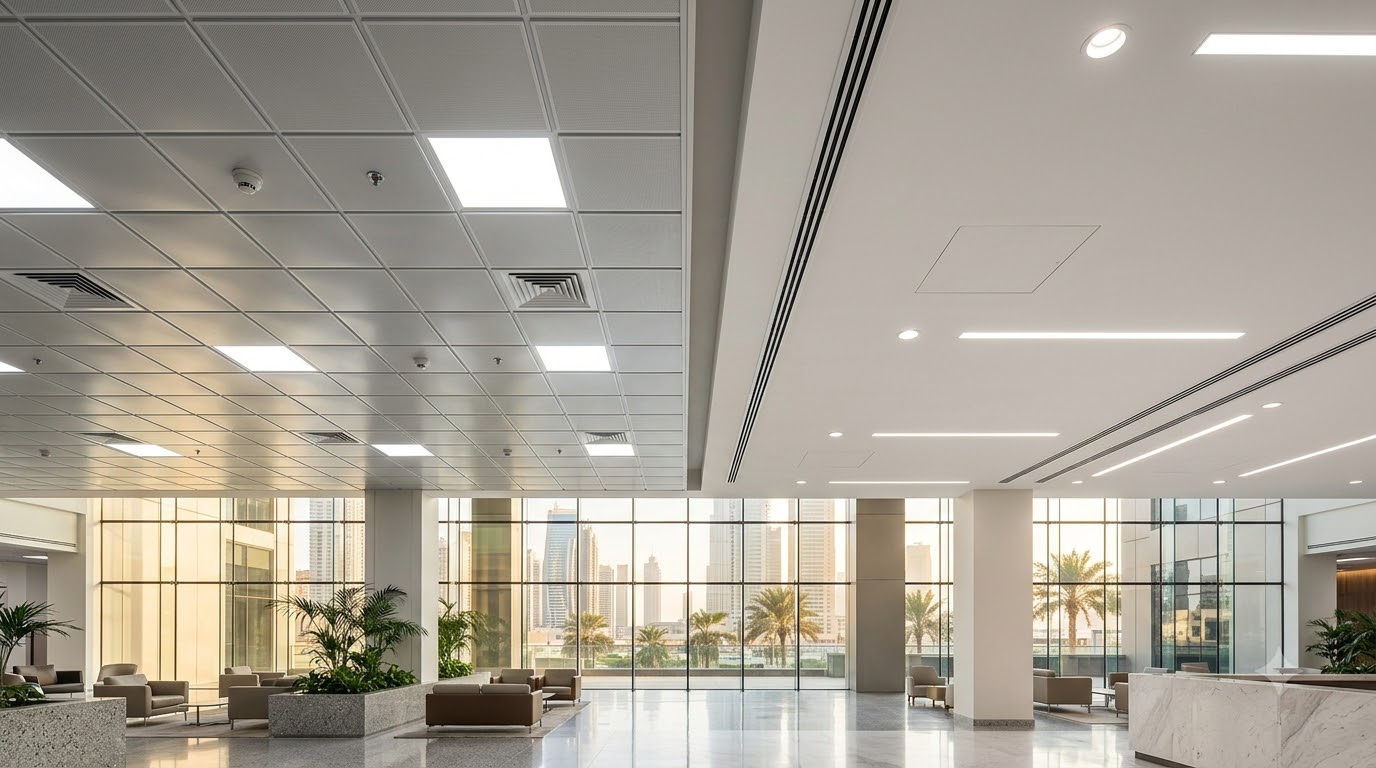
A ceiling tile can look perfectly fine on installation day. Six months later, the real story starts to show. Humidity, constant air conditioning, maintenance work and the occasional leak can all test the ceiling above you. That is why asking for the best ceiling tile for UAE climate aluminium or gypsum is worth doing before the material reaches site.
There is no automatic winner. Aluminium is a strong choice where moisture and frequent maintenance are concerns. Gypsum suits many dry, air-conditioned interiors and gives a softer, familiar finish. GTI supplies both types for UAE projects. Here is how to decide which one makes more sense for your space.
Best Ceiling Tile for UAE Climate Aluminium or Gypsum?
Start with the room, not the catalogue. A hotel corridor, office, hospital service area and coastal property do not put the same demands on a ceiling.
Aluminium generally makes more sense where moisture, cleaning or regular ceiling access is expected. Gypsum is often a good fit for dry interiors where budget and a simple finished look carry more weight. The exact product still matters. A standard gypsum tile and a humidity-resistant tile should not be treated as if they are the same material.
For project budgeting, it is also useful to understand suspended ceiling installation costs in the UAE in 2026, as the selected ceiling system and material can significantly affect the overall price.
GTI’s commercial ceiling system guide is useful when the decision also involves the grid, access and room use.
Why the UAE Climate Makes This Choice Important
Walk from a cooled lobby into a humid service area and the change is obvious. Building materials feel that change too. Moisture can also appear around HVAC equipment or after an AC drain problem.
This is where specifications matter. ASTM C1396/C1396M covers several gypsum board products, including gypsum ceiling board and water-resistant gypsum board. In other words, “gypsum” on its own does not tell you enough about how a product will perform.
A sensible comparison ceiling materials UAE exercise should therefore look at the actual room, expected humidity and maintenance conditions. GTI also covers this point in its high-humidity ceiling tile guide.
The same environmental factors should be considered when selecting partition framing, particularly when comparing GI vs aluminium profiles for UAE projects.
Aluminium Ceiling Tiles vs Gypsum UAE: What Changes in Practice?
The quotation is only one part of the decision. Think about the ceiling after handover: who cleans it, how often technicians open it, and what happens if the area becomes damp.
| Factor | Aluminium Ceiling Tiles | Gypsum Ceiling Tiles |
| Moisture resistance | Strong | Depends on tile grade |
| Weight | Light | Usually heavier than aluminium |
| Cleaning | Usually simple | Depends on surface finish |
| Ceiling access | Simple with removable systems | Simple with lay-in tiles |
| Look | Crisp and commercial | Soft and familiar |
| Design options | Plain, perforated, coated | Different patterns and finishes |
| Humid spaces | Often well suited | Select a rated product |
| Upkeep | Usually low | Depends on room conditions |
Best Ceiling Tile for UAE Climate Aluminium or Gypsum in Humid Areas?
If the room regularly faces humidity, aluminium deserves a closer look. It does not absorb moisture like a porous ceiling material can, and this is one reason it is widely specified in UAE commercial projects. GTI’s aluminium ceiling tile guide notes its resistance to moisture, warping and rust.
That does not mean gypsum is wrong for the UAE. It means the grade has to match the room. Moisture-resistant or faced tiles can be suitable for controlled conditions. When weighing aluminium ceiling tiles vs gypsum UAE, ask for the humidity rating rather than relying on the material name alone.
Durability and Maintenance
This is where owners and facility teams often see the difference. A ceiling that needs repeated touch-ups can become inconvenient even if it was cheaper to buy.
Aluminium tiles are easy to wipe and individual removable tiles can usually be taken out when work is needed above the ceiling. Gypsum also lasts well in the right indoor setting, but an unsuitable tile may show the effects of repeated moisture exposure sooner.
So the best ceiling tile for UAE climate aluminium or gypsum is not simply the one with the lower supply price. The amount of care it will need over the years matters too.
Which One Looks Better?
This part is personal. Gypsum has the quiet, simple appearance people already know from offices, corridors and residential interiors. It blends into a room rather than drawing attention to itself.
Aluminium can feel sharper and more architectural. Plain and perforated tiles, along with lay-in or clip-in formats, give designers more ways to create a visible ceiling pattern. For a comparison ceiling materials UAE brief, it helps to decide whether the ceiling should disappear into the room or become part of its design.
Fire Performance Needs a Document Check
Do not choose either material on a general claim such as “metal is safe” or “gypsum is fire resistant.” Fire requirements apply to specified products and systems.
ASTM C1396 describes gypsum board as having a core that is essentially gypsum and non-combustible. GTI also publishes fire-performance information for its aluminium ceiling systems. The practical step for a project team is simple: ask for the relevant test report and make sure it matches the ceiling system being proposed.
Do Not Forget Acoustics
Metal does not automatically mean a noisy room. Perforated aluminium tiles can be paired with acoustic backing where sound absorption is needed. Gypsum ceiling products can also form part of an acoustic system, depending on their design.
Meeting rooms, offices and public areas should be checked for acoustic needs early. GTI’s guide to acoustic ceiling systems and NRC ratings gives a useful starting point.
Installation and Ceiling Access Matter More Than You Think
Imagine an electrician needing to reach a cable above the ceiling every few months. Suddenly, easy access matters just as much as colour or finish.
Lay-in tiles can be lifted individually, making service work straightforward. Clip-in systems give a more closed, neat appearance but still need a planned access approach. GTI’s T-Grid Suspension System is listed for use with aluminium and gypsum tiles and is direct hung in line with ASTM C636/C636M.
The GTI guide to exposed and concealed T-grid ceilings also helps explain the trade-off between appearance, access and budget.
Best Ceiling Tile for UAE Climate Aluminium or Gypsum: What About Cost?
Gypsum can be attractive when the project needs a straightforward ceiling at a controlled starting cost. Aluminium may cost more depending on its thickness, finish, perforation and fixing system. But comparing only the first quotation can be misleading.
Consider:
- expected service life;
- cleaning needs;
- moisture exposure;
- replacement frequency;
- access to MEP services;
- repainting or repair needs;
- project downtime during maintenance.
In a busy building, easy cleaning and simple tile replacement may justify spending more at the start. In a dry office or corridor, gypsum may do the job without paying for performance the room does not need. This is why aluminium ceiling tiles vs gypsum UAE is better treated as a value decision than a cheapest-price contest.
Where GTI Fits into the Decision
GTI makes the choice easier by helping project teams look beyond the tile itself. The room, ceiling grid and long-term use all matter.
For large commercial projects, material selection should also be supported by a reliable supply chain, making it useful to understand how to select a reliable building material manufacturer in UAE for large projects.
- More ceiling choices: Compare aluminium and gypsum options based on the needs of each space.
- Complete system approach: Match ceiling tiles with the right suspension and T-grid system.
- Better fit for UAE projects: Choose materials with humidity, maintenance and everyday building use in mind.
- One project, different solutions: Use aluminium in demanding areas and gypsum where conditions are more controlled.
- Practical product guidance: Explore the GTI complete ceiling systems guide when making a comparison ceiling materials UAE for your project.
The answer to the best ceiling tile for UAE climate aluminium or gypsum depends on where the ceiling is going. Aluminium has a clear advantage in humid, busy or maintenance-heavy spaces. Gypsum remains a sensible choice for many dry, air-conditioned interiors where a clean finish and controlled budget matter.
Need help narrowing the choice? Contact GTI about a ceiling system that fits the room, not just the drawing.
FAQs
1. What is the best ceiling tile for UAE climate aluminium or gypsum?
For humid or demanding areas, aluminium is often the easier choice. For dry, controlled interiors, the right gypsum tile can be practical and cost-effective.
2. What is the main difference between aluminium ceiling tiles vs gypsum UAE?
Moisture behaviour is one of the biggest differences. Aluminium does not absorb moisture, while gypsum performance depends on the grade, facing and rated conditions.
3. Can gypsum ceiling tiles be used in the UAE?
Yes. They are suitable for many indoor spaces. The important point is to choose a tile whose humidity and performance ratings match the room.
4. Are aluminium tiles a good choice near the coast?
They can be. For coastal projects, check the finish, grid, fixings and complete system specification rather than judging the tile alone.
- Which ceiling is easier to maintain?
Removable aluminium tilings is usually easy to clean as well as replace. Lay-in gypsum tiles are also well accessible, though the tile must be covered against exposure to excessive moisture.
- Which material looks more modern?
Aluminium tends to offer a cleaner commercial appearance. Gypsum is more subdued and fits best when the ceiling is intended to be seamlessly incorporated into the interiors.
- Are aluminium tiles applicable to acoustic ceiling?
Yes. When it is necessary to include sound absorption into the room design, perforated aluminium tiles can be used in combination with appropriate acoustic backing.
- Which is better for an office ceiling?
Both can work. Aluminium or gypsum ceiling tiles, depending on the appearance, humidity, acoustic target, maintenance, and cost, are the best ceiling tiles to use in the UAE climate.
- What should a comparison of ceiling materials UAE checklist entail?
Check humidity, fire, acoustic considerations, cleaning, access above the ceiling, grid, product, documents and anticipated maintenance cost.
- Can one building use both aluminium and gypsum ceilings?
Absolutely. It is actually more realistic to select by room rather than to incorporate some form of material everywhere. Aluminium can handle demanding zones while gypsum serves suitable dry interiors.
Every ceiling and partition system installed in a UAE commercial building carries two obligations that cannot be traded off against each other. The first is fire safety. The second is acoustic performance.
Regulations govern the first. Occupant comfort and productivity depend on the second. In most commercial projects across Abu Dhabi and Dubai, both requirements apply simultaneously, and the materials and systems specified need to address both without compromise.
This guide covers what fire safety and acoustic requirements actually mean for ceiling and partition systems in the UAE, how they are measured and tested, what the regulations say, and how to specify systems that meet both sets of demands on the same project.
Why These Two Requirements Are Always Connected
Fire safety and acoustic performance are not separate specification exercises. They are linked at the level of the wall and ceiling assembly itself. A fire-rated partition that allows sound to travel freely between spaces is a compliance failure on one axis. An acoustically treated ceiling that has not been tested for fire resistance may fail Civil Defence inspection on another.
The materials that provide fire resistance, dense gypsum board, mineral wool insulation, heavy gauge GI framing, often also contribute to acoustic performance. The mass of a fire-rated wall assembly is part of what makes it resistant to both flame spread and sound transmission. Understanding this relationship means better specifications, fewer clashes between disciplines, and less rework on site.
Fire Safety Requirements for Ceiling Systems in UAE
The fire safety requirements for ceiling systems in the UAE are set by Civil Defence authorities in each emirate, with Dubai Civil Defence and Abu Dhabi Civil Defence being the two primary regulatory bodies for most commercial construction. These requirements reference international testing standards and specify where fire-rated assemblies are mandatory within a building.
Fire resistance for ceiling systems is expressed as a time rating. The assembly is tested in a laboratory by exposing one face to fire conditions while monitoring the opposite face for heat transfer, structural integrity, and the passage of flame or smoke. The rating, whether 30, 60, 90, or 120 minutes, represents how long the assembly maintains its performance under those conditions.
The most widely referenced test standards in UAE construction are BS 476 and ASTM E119. Some projects also reference EN 1364. The project’s Civil Defence approval drawings will specify which standard applies and what rating is required in each location.
Fire-rated ceiling assemblies are mandatory in escape corridors, stairwells, lift lobbies, plant rooms, and any ceiling above a fire-rated partition where continuity of the fire compartment needs to be maintained. The ceiling is part of the fire compartment boundary in these locations, not a separate finishing element.
A critical point that is often misunderstood on UAE projects is that a fire-rated ceiling assembly is a tested and certified system. The rating belongs to the complete assembly, including the specific grid profile, tile type and thickness, hanger spacing, and any insulation above. Changing any single component can invalidate the certification. This means specification decisions about grid and tile cannot be made independently of fire rating requirements.
Fire Rated Ceiling UAE Standards: What Compliance Actually Requires
Meeting fire-rated ceiling UAE standards requires more than selecting a product described as fire-resistant. It requires identifying the tested assembly that matches the project’s fire rating requirement, specifying every component of that assembly exactly as tested, and installing it in accordance with the manufacturer’s installation instructions and the test certificate.
The documentation required to demonstrate compliance typically includes the fire test certificate for the assembly, product data sheets for each component, and in many cases a method statement showing how the installation will be carried out. Civil Defence inspectors in Dubai and Abu Dhabi may request this documentation during inspection, and missing paperwork can result in instructions to replace work that cannot be verified as compliant.
For ceiling systems, the non-combustibility of the tile material is a baseline requirement in most commercial locations. Standard mineral fibre tiles and aluminium tiles are both non-combustible. However, non-combustibility alone does not constitute a fire-rated assembly. The full assembly, tested and certified to the required rating, is what compliance demands.
Partition Wall Fire Requirements in UAE Buildings
Partition walls in UAE commercial buildings are subject to fire performance requirements that vary by location and building type. The walls separating individual units in residential towers, corridors from occupied spaces, plant rooms from the rest of the building, and stairwells from floor plates all carry specific fire resistance ratings that must be achieved by the partition assembly.
The GI stud and track framing, the gypsum board type and number of layers, the insulation inside the cavity, and the way penetrations are sealed all contribute to the fire resistance of a partition wall. As with ceiling systems, the rating belongs to the complete tested assembly. A partition built with fire-rated board but using a lighter gauge stud than the tested assembly specifies may not achieve the stated rating.
Penetrations through fire-rated partitions are one of the most common compliance failures on UAE construction sites. Every opening made for a pipe, cable, duct, or other service must be sealed with a fire-rated sealant or intumescent material rated to match or exceed the partition’s fire rating. An unsealed penetration effectively removes the fire barrier at that point regardless of how well the rest of the wall is constructed.
For projects specifying partition walls for tall or heavily loaded applications, understanding the right GI stud size is essential to maintaining both structural integrity and fire rating compliance.
[Read our guide on what GI stud size to use for 4 metre high partition walls in UAE for detailed specification guidance on tall wall framing.]
Acoustic Performance Requirements for Ceiling Systems
Acoustic performance in ceiling systems is measured using the Noise Reduction Coefficient, or NRC. This scale runs from 0 to 1 and describes how much sound energy a surface absorbs rather than reflects into the space. A ceiling tile with an NRC of 0.70 absorbs 70 percent of the sound that reaches it.
The acoustic performance ceiling UAE commercial projects require varies by space type. Open-plan offices need NRC ratings of 0.70 or above to control ambient noise across large floor plates. Healthcare consultation rooms, classrooms, and spaces where speech privacy matters need higher ratings and may also require attention to ceiling attenuation class, which measures how much sound travels through the ceiling void between adjacent spaces.
Mineral fibre ceiling tiles are the standard acoustic solution for UAE commercial projects. They are available across a wide NRC range, compatible with standard T-grid systems, and cost-effective for large ceiling areas. High-performance acoustic tiles with NRC ratings above 0.80 are available for spaces with demanding acoustic targets.
For a full breakdown of which ceiling tiles deliver the best acoustic performance for UAE offices and the local climate, [see our dedicated guide on the best ceiling tiles for acoustic performance in UAE offices and climate.]
Acoustic Requirements for Partition Walls
Partition walls in commercial buildings need to control sound transmission between spaces as well as provide fire separation. The measure used for sound transmission through walls is the Sound Transmission Class, or STC. A higher STC rating means less sound passes through the partition.
Standard single-layer gypsum board partitions on GI stud framing achieve STC ratings in the range of 35 to 40, which is adequate for low-privacy applications such as open-plan dividers. For private offices, meeting rooms, and spaces where speech confidentiality is important, STC ratings of 45 to 55 are typically targeted. Achieving these higher ratings requires additional board layers, resilient channels to decouple the board from the stud, acoustic insulation in the cavity, and careful attention to flanking paths where sound bypasses the wall through the floor, ceiling, or adjacent structure.
If your project includes office partitions that need to achieve specific acoustic targets, the way the drywall system is detailed makes a significant difference to the result. [Our guide on how to soundproof office partition walls in the UAE using drywall covers the specific techniques and material combinations that achieve higher STC ratings in UAE commercial fit-outs.]
How Fire and Acoustic Requirements Interact in the Same Assembly
The relationship between fire performance and acoustic performance in wall and ceiling assemblies is generally complementary. The features that improve fire resistance tend to also improve acoustic performance, and vice versa.
Adding layers of gypsum board to a partition increases both its fire resistance and its sound transmission class. Filling the stud cavity with mineral wool insulation improves the thermal and acoustic performance of the assembly and also contributes to fire resistance because mineral wool is non-combustible and slows heat transfer through the wall. Using a heavier gauge stud keeps the wall more rigid, which benefits both structural performance under fire conditions and the transmission loss of the partition.
This means specifying a fire-rated partition assembly often provides a useful acoustic performance baseline without any additional design effort. The challenge is in the other direction: achieving high acoustic performance in a non-fire-rated location sometimes requires assembly configurations, such as decoupled resilient channel construction, that need to be carefully checked against fire rating requirements if the wall location later changes.
UAE Building Code and Civil Defence Compliance
UAE building regulations covering interior partition and ceiling fire performance draw from a combination of local Civil Defence requirements, Dubai Municipality and Abu Dhabi Department of Municipalities and Transport guidelines, and internationally referenced standards.
For commercial projects, Civil Defence approval is required before construction begins, and the fire performance specifications for walls and ceilings are reviewed as part of that process. Inspections during and after construction verify that the installed systems match the approved drawings. Deviations from approved specifications, even minor ones, can result in required remediation before a completion certificate is issued.
Understanding the full scope of UAE building code requirements for interior partition walls, including what is mandated, what is recommended, and where the regulations leave room for engineering judgment, is essential groundwork for any commercial project.
[Our guide on UAE building code requirements for interior partition walls covers the regulatory framework in detail and explains what compliance looks like in practice for different building types and partition locations.]
Specifying Systems That Meet Both Requirements
The practical starting point for specifying ceiling and partition systems that meet both fire safety and acoustic requirements in the UAE is to identify the fire rating requirement for each location first. Fire requirements are regulatory and non-negotiable. Once the fire-rated assembly is confirmed, the acoustic performance of that assembly can be assessed and supplemented if needed.
In most cases, a properly specified fire-rated partition or ceiling assembly will provide a reasonable acoustic baseline. If the acoustic target for the space exceeds what the fire-rated assembly delivers on its own, additional measures, such as acoustic insulation with a higher density, additional board layers, or resilient mounting details, can be incorporated while keeping the assembly within the tested and certified configuration.
Working with a supplier who understands both sets of requirements and can provide the right combination of products for each location is the most efficient way to move from specification to procurement without errors or omissions.
What to Have Ready Before Specifying
Before finalizing ceiling and partition specifications on a UAE commercial project, the following information should be confirmed. The Civil Defence-approved drawings showing fire rating requirements for each wall and ceiling zone. The acoustic performance targets for each space type, either from an acoustic consultant or from building type guidelines. The structural slab details, including whether the slab is post-tensioned, which affects the hanger fixing method for ceilings. The MEP coordination drawings showing service locations above ceilings and penetrations through partitions. And the lead times and local availability of the specified products, particularly for fire-rated assemblies and high-performance acoustic tiles that may not be standard stock items.
Having this information before products are specified prevents the common situation where a system is selected, procurement begins, and a Civil Defence comment or a coordination clash forces a specification change after materials are already on order.
Conclusion
Fire safety and acoustic performance are the two non-negotiable technical requirements for ceiling and partition systems in UAE commercial buildings. They are set by different authorities and measured by different standards, but they are addressed by the same materials, the same assemblies, and the same installation decisions. Getting both right from the start of the specification process is straightforward when you understand what each requirement demands and how the two sets of criteria interact in a real assembly.
GTI supplies fire-rated gypsum boards, acoustic ceiling tiles, mineral fibre systems, GI and aluminium drywall profiles, and all associated framing components for commercial projects across the UAE.
Whether you are specifying a complete ceiling and partition package or sourcing specific products to meet a Civil Defence or acoustic requirement, our team can help you identify the right products and confirm availability for your project timeline.
Contact us to discuss your requirements.
Frequently Asked Questions
- What are the fire safety requirements for ceiling systems in UAE commercial buildings? Civil Defence authorities in Dubai and Abu Dhabi require fire-rated ceiling assemblies in escape corridors, stairwells, lift lobbies, plant rooms, and anywhere the ceiling forms part of a fire compartment boundary.
- What test standards are used for fire-rated ceiling UAE compliance? The most commonly referenced standards for fire-rated ceiling systems in UAE projects are BS 476, ASTM E119, and EN 1364, with the applicable standard specified in the Civil Defence approval drawings.
- What NRC rating should ceiling tiles have to meet acoustic performance requirements in UAE offices? Open-plan offices in the UAE generally require ceiling tiles with an NRC rating of 0.70 or above, with higher ratings recommended for spaces where speech privacy or noise reduction is a priority.
- Can the same partition assembly meet both fire and acoustic requirements in a UAE building? Yes, fire-rated partition assemblies typically provide a useful acoustic performance baseline because the features that improve fire resistance, such as additional board layers and mineral wool insulation, also improve sound transmission class.
- What happens if a penetration through a fire-rated partition is not sealed on a UAE project? An unsealed penetration through a fire-rated partition removes the fire barrier at that point and constitutes a compliance failure that will need to be rectified before a completion certificate can be issued.
- Who is responsible for ensuring ceiling and partition fire ratings are met on UAE construction projects? The main contractor and fit-out company are responsible for ensuring the correct assemblies are installed as specified, with documentation available for Civil Defence inspection.
- Does mineral wool insulation inside a partition cavity improve both fire and acoustic performance in UAE buildings? Yes, mineral wool is non-combustible and slows heat transfer, which contributes to fire resistance, while also absorbing sound within the cavity, which improves the acoustic performance of the partition.
- Are aluminium ceiling tiles compliant with fire safety requirements for UAE commercial buildings? Aluminium ceiling tiles are non-combustible, but compliance with fire safety requirements depends on the complete tested and certified assembly rather than the tile material alone.
- How does ceiling attenuation class affect acoustic performance in UAE open-plan offices? Ceiling attenuation class measures how much sound travels through the ceiling void between adjacent spaces, which is particularly important in open-plan UAE offices where partial-height partitions are used and sound travels over partition tops.
- What documentation is needed to prove fire rating compliance for ceiling and partition systems on UAE projects? The required documentation typically includes the fire test certificate for the assembly, product data sheets for all components, and a method statement showing how the system was installed in accordance with the tested configuration.