September 10, 2026
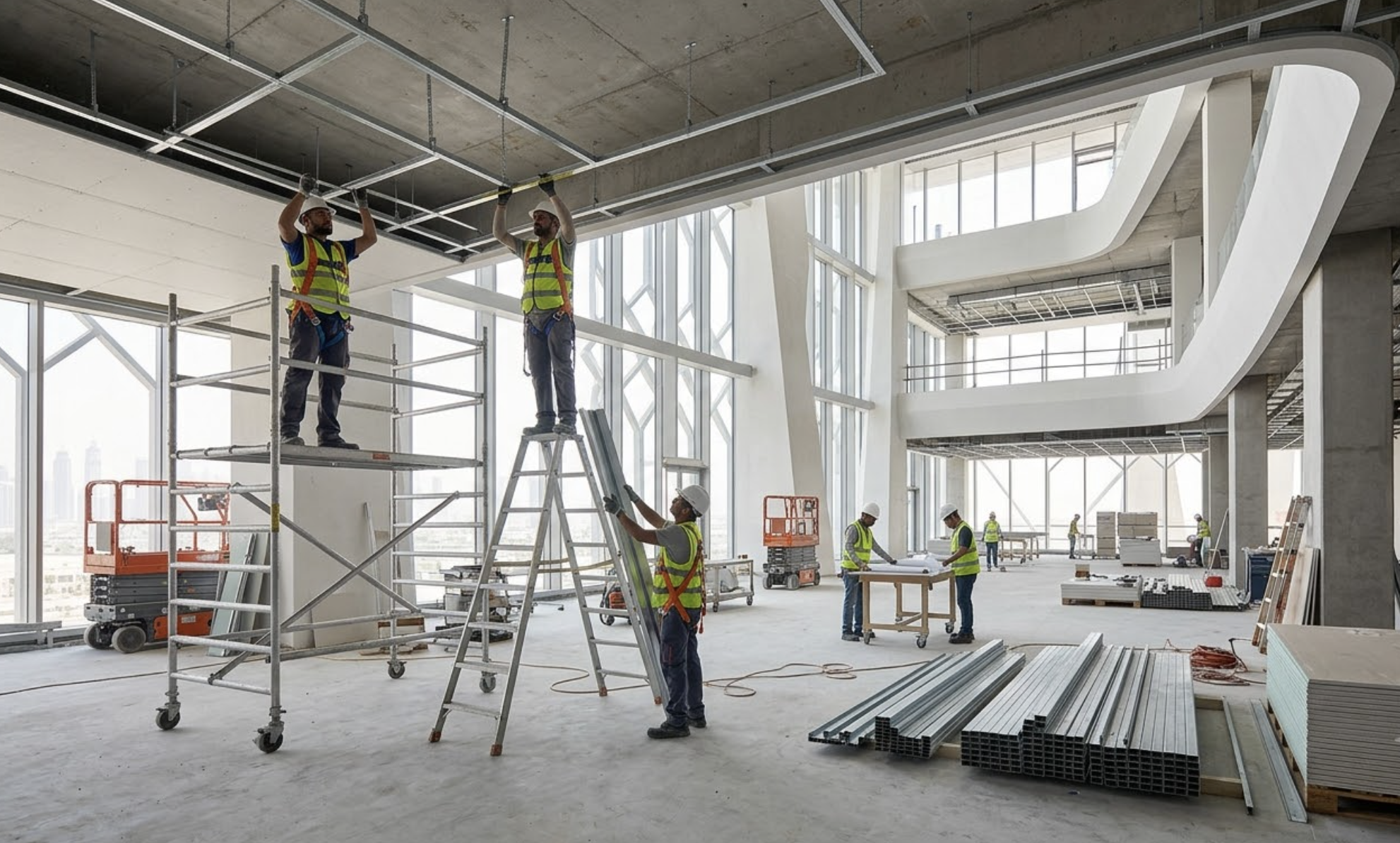
A ceiling grid arrives late. Drywall work stops. Other trades wait, and a small supply problem starts affecting the whole project. Material sourcing can have a bigger impact than many buyers expect.
At GTI, understanding the building material manufacturer UAE advantages can help contractors, consultants, developers, and procurement teams make smarter buying choices. Local production can mean shorter supply routes, easier support, and better access to key components. Choosing made in UAE building materials can also help teams respond faster when project needs change. When supply is supported by a local GI coil manufacturer UAE, buyers can gain closer visibility into a key material used in ceiling and drywall profiles.
Building Material Manufacturer UAE Advantages for UAE Projects
Choosing a supplier is not only about comparing prices. Buyers also need to consider product quality, stock, lead time, technical details, and the risk of project delays.
The main building material manufacturer UAE advantages come from being closer to the project. A local manufacturer understands UAE construction needs and can communicate directly with customers.
For budgeting a suspended ceiling project, our guide to suspended ceiling installation cost in UAE in 2026 explains the main factors that influence supply and installation pricing.
The UAE’s Operation 300Bn strategy aims to strengthen the industrial sector and increase its role in the national economy.It targets raising the sector’s GDP contribution from AED 133 billion to AED 300 billion by 2031.
For a detailed checklist on evaluating manufacturers for major projects, read how to select a reliable building material manufacturer in UAE for large projects.
Faster Supply Is One of the Building Material Manufacturer UAE Advantages
Long-distance imports may pass through factories, ports, shipping lines, customs, warehouses, and distributors before reaching a site. Local production can shorten this chain.
This matters when a contractor suddenly needs more studs, tracks, main channels, furring channels, or ceiling accessories.
GTI’s drywall partitioning system uses metal studs with floor and ceiling tracks to form the frame for plasterboard. Its furring ceiling system combines furring channels, main channels, wall trims, and related components.
For fast fit-out work, this is one of the most useful building material manufacturer UAE advantages.
Why Made in UAE Building Materials Make Sense
Local sourcing gives buyers easier access to the source of the product. Questions about dimensions, thickness, applications, and availability can be handled closer to the project.
Made in UAE building materials can therefore be useful when drawings change or quantities increase during construction. Buyers can also discuss complete systems rather than trying to match parts from several unrelated sources.
For further product planning, GTI’s Complete Guide to Ceiling Systems UAE explains suspension, T-grid, and aluminium ceiling options. Contractors can also use the Drywall Systems UAE Contractor’s Guide when planning partition systems.
The Role of a Local GI Coil Manufacturer UAE
GI steel is widely used to form studs, tracks, channels, angles, and other interior framing parts. Working with a local GI coil manufacturer UAE can bring the steel supply chain closer to the finished product.
This can make it easier to discuss thickness, coating, processing, profile requirements, and production planning.
ASTM C645 covers non-structural steel framing members used in interior assemblies. It requires steel framing members covered by the standard to have a protective coating and sets performance requirements for these products. ASTM C645 Standard for Nonstructural Steel Framing
A reliable local GI coil manufacturer UAE should therefore be assessed on technical capability, quality checks, documentation, and consistency—not location alone.
When selecting profiles for different UAE environments, see our comparison of GI vs aluminium profiles for UAE projects.
Local vs Imported Ceiling and Drywall Systems
The right source depends on each project’s needs. Still, the building material manufacturer UAE advantages become clear when buyers compare the full supply process.
| Buying factor | Local UAE manufacturer | Long-distance imported supply |
| Communication | Direct local contact | May involve more parties |
| Reorders | Potentially faster | Linked to import cycles |
| Project changes | Easier local discussion | More advance planning may be needed |
| Stock visibility | Easier to follow up | Depends on importer |
| Technical support | Close to UAE market | Varies by brand and supplier |
| Logistics | Shorter supply route | More shipping stages |
Local does not automatically mean better. Buyers must still check specifications, tests, approvals, manufacturing ability, and delivery performance.
Building Material Manufacturer UAE Advantages for Quality
Quality ceiling and drywall systems depend on more than appearance. Dimensions, metal thickness, coating, profile shape, connection, and installation can all affect performance.
ASTM C635/C635M covers the manufacture, performance, and testing of metal suspension systems used for acoustical tiles and lay-in ceiling panels. ASTM C635/C635M Ceiling Suspension Standard
Green building certificates and Conformity Marks from Dubai Central Laboratory help verify that building products meet approved standards. They support safer, higher-quality, and more sustainable construction in Dubai.
One of the building material manufacturer UAE advantages is easier discussion of these requirements with a supplier operating in the same market. Project specifications and authority requirements should always guide final approval.
Building Material Manufacturer UAE Advantages When Checking Products
Before approving made in UAE building materials, use the same careful checks you would apply to imported products.
Buyers should review:
- Material type and coating
- Profile dimensions and thickness
- Relevant test reports
- Product or system compatibility
- Required approvals
- Production and delivery capacity
GTI’s GI Drywall Studs & Tracks UAE Specification Guide gives contractors useful information on framing sizes, thickness ranges, and applications.
These checks turn the building material manufacturer UAE advantages into real project value rather than simply choosing a product because it is locally produced.
Why Local Supply Works for Fast UAE Projects
Ceiling work rarely happens alone. Installers must coordinate grids and panels with lighting, HVAC, sprinklers, access panels, and other services.
The same applies to drywall. Electrical and other services often pass through or around the framing.
Using made in UAE building materials can support phased buying because additional material may be easier to source locally. GTI’s Suspended Ceiling Installation UAE Guide also highlights the importance of coordinating services before completing the ceiling grid.
This makes local availability useful for offices, hotels, hospitals, schools, malls, airports, and residential projects.
For projects where ceiling material selection depends on humidity and maintenance conditions, read our guide on aluminium vs gypsum ceiling tiles for the UAE climate.
Building Material Manufacturer UAE Advantages: Why Consider GTI?
Choosing GTI gives contractors, developers, and procurement teams practical local support for ceiling and drywall projects.
- Local UAE manufacturing: Easier sourcing for fast-moving projects.
- Reliable product range: Ceiling, drywall, GI profiles, and accessories from one source.
- Faster supply: Shorter local supply routes can help reduce waiting time.
- Quality-focused products: Clear specifications help buyers choose with confidence.
- Local project support: Get quicker answers for product and project needs.
- Flexible sourcing: Easier repeat orders when site quantities change.
These building material manufacturer UAE advantages make GTI a practical choice for reliable ceiling and drywall solutions across the UAE.
Choose reliable ceiling and drywall systems made for UAE projects. Contact GTI today to discuss your project requirements and find the right solution.
FAQs
1. What are the main building material manufacturer UAE advantages?
The main building material manufacturer UAE advantages include shorter supply routes, easier communication, quicker response to changing quantities, and better access to local product support.
- Why prefer building materials made in the UAE?
Building materials made in the UAE may simplify sourcing and repeat orders. The buyer must not purchase without checking the specifications, test approvals, and capacity of the manufacturer.
- What do I enquire of a local GI coil manufacturer UAE?
Enquire of a local GI coil manufacturer UAE regarding steel grade, coating, thickness and processing, quality checks, manufacturing capacity, documentation and expected lead time.
- Are local ceiling systems always better than imported systems?
No. Quality is not guaranteed by location. Compare specifications, system performance, testing, approvals, delivery and technical support.
- What can local manufacturing do to assist drywall contractors?
Among the benefits of building material manufacturers in the UAE is easier replacement for contractors requiring additional studs, tracks, channels, or accessories during a project.
- Do UAE-made products fit in big projects?
Yes, provided that the manufacturer possesses the appropriate capacity, product specifications, quality controls, documentation and a stable supply procedure.
- What is the importance of GI quality in drywall framing?
GI profiles are created as the frame behind plasterboard. The right thickness, form or shape, coating, spacing, and installation ensure the completed system functions as expected.
- Do UAE manufacturers accommodate quantity modification of projects?
The capabilities will differ, and the ability to make changes in quantity might be easier to consider in other situations, whereas the supplier and manufacturing process are near the project.
- How do local manufacturers help procurement teams?
The benefits of the building material manufacturer UAE to procurement are the facilitation of stock checks, direct communication, reduced supply channels, and faster negotiation on a specification or quantity variation.
- What do buyers look at when choosing a manufacturer of ceiling or drywall?
Specification of check products, quality of the material, test reports, compatibility with the system, approvals, manufacturing capacity, delivery history, and support.
Every ceiling and partition system installed in a UAE commercial building carries two obligations that cannot be traded off against each other. The first is fire safety. The second is acoustic performance.
Regulations govern the first. Occupant comfort and productivity depend on the second. In most commercial projects across Abu Dhabi and Dubai, both requirements apply simultaneously, and the materials and systems specified need to address both without compromise.
This guide covers what fire safety and acoustic requirements actually mean for ceiling and partition systems in the UAE, how they are measured and tested, what the regulations say, and how to specify systems that meet both sets of demands on the same project.
Why These Two Requirements Are Always Connected
Fire safety and acoustic performance are not separate specification exercises. They are linked at the level of the wall and ceiling assembly itself. A fire-rated partition that allows sound to travel freely between spaces is a compliance failure on one axis. An acoustically treated ceiling that has not been tested for fire resistance may fail Civil Defence inspection on another.
The materials that provide fire resistance, dense gypsum board, mineral wool insulation, heavy gauge GI framing, often also contribute to acoustic performance. The mass of a fire-rated wall assembly is part of what makes it resistant to both flame spread and sound transmission. Understanding this relationship means better specifications, fewer clashes between disciplines, and less rework on site.
Fire Safety Requirements for Ceiling Systems in UAE
The fire safety requirements for ceiling systems in the UAE are set by Civil Defence authorities in each emirate, with Dubai Civil Defence and Abu Dhabi Civil Defence being the two primary regulatory bodies for most commercial construction. These requirements reference international testing standards and specify where fire-rated assemblies are mandatory within a building.
Fire resistance for ceiling systems is expressed as a time rating. The assembly is tested in a laboratory by exposing one face to fire conditions while monitoring the opposite face for heat transfer, structural integrity, and the passage of flame or smoke. The rating, whether 30, 60, 90, or 120 minutes, represents how long the assembly maintains its performance under those conditions.
The most widely referenced test standards in UAE construction are BS 476 and ASTM E119. Some projects also reference EN 1364. The project’s Civil Defence approval drawings will specify which standard applies and what rating is required in each location.
Fire-rated ceiling assemblies are mandatory in escape corridors, stairwells, lift lobbies, plant rooms, and any ceiling above a fire-rated partition where continuity of the fire compartment needs to be maintained. The ceiling is part of the fire compartment boundary in these locations, not a separate finishing element.
A critical point that is often misunderstood on UAE projects is that a fire-rated ceiling assembly is a tested and certified system. The rating belongs to the complete assembly, including the specific grid profile, tile type and thickness, hanger spacing, and any insulation above. Changing any single component can invalidate the certification. This means specification decisions about grid and tile cannot be made independently of fire rating requirements.
Fire Rated Ceiling UAE Standards: What Compliance Actually Requires
Meeting fire-rated ceiling UAE standards requires more than selecting a product described as fire-resistant. It requires identifying the tested assembly that matches the project’s fire rating requirement, specifying every component of that assembly exactly as tested, and installing it in accordance with the manufacturer’s installation instructions and the test certificate.
The documentation required to demonstrate compliance typically includes the fire test certificate for the assembly, product data sheets for each component, and in many cases a method statement showing how the installation will be carried out. Civil Defence inspectors in Dubai and Abu Dhabi may request this documentation during inspection, and missing paperwork can result in instructions to replace work that cannot be verified as compliant.
For ceiling systems, the non-combustibility of the tile material is a baseline requirement in most commercial locations. Standard mineral fibre tiles and aluminium tiles are both non-combustible. However, non-combustibility alone does not constitute a fire-rated assembly. The full assembly, tested and certified to the required rating, is what compliance demands.
Partition Wall Fire Requirements in UAE Buildings
Partition walls in UAE commercial buildings are subject to fire performance requirements that vary by location and building type. The walls separating individual units in residential towers, corridors from occupied spaces, plant rooms from the rest of the building, and stairwells from floor plates all carry specific fire resistance ratings that must be achieved by the partition assembly.
The GI stud and track framing, the gypsum board type and number of layers, the insulation inside the cavity, and the way penetrations are sealed all contribute to the fire resistance of a partition wall. As with ceiling systems, the rating belongs to the complete tested assembly. A partition built with fire-rated board but using a lighter gauge stud than the tested assembly specifies may not achieve the stated rating.
Penetrations through fire-rated partitions are one of the most common compliance failures on UAE construction sites. Every opening made for a pipe, cable, duct, or other service must be sealed with a fire-rated sealant or intumescent material rated to match or exceed the partition’s fire rating. An unsealed penetration effectively removes the fire barrier at that point regardless of how well the rest of the wall is constructed.
For projects specifying partition walls for tall or heavily loaded applications, understanding the right GI stud size is essential to maintaining both structural integrity and fire rating compliance.
[Read our guide on what GI stud size to use for 4 metre high partition walls in UAE for detailed specification guidance on tall wall framing.]
Acoustic Performance Requirements for Ceiling Systems
Acoustic performance in ceiling systems is measured using the Noise Reduction Coefficient, or NRC. This scale runs from 0 to 1 and describes how much sound energy a surface absorbs rather than reflects into the space. A ceiling tile with an NRC of 0.70 absorbs 70 percent of the sound that reaches it.
The acoustic performance ceiling UAE commercial projects require varies by space type. Open-plan offices need NRC ratings of 0.70 or above to control ambient noise across large floor plates. Healthcare consultation rooms, classrooms, and spaces where speech privacy matters need higher ratings and may also require attention to ceiling attenuation class, which measures how much sound travels through the ceiling void between adjacent spaces.
Mineral fibre ceiling tiles are the standard acoustic solution for UAE commercial projects. They are available across a wide NRC range, compatible with standard T-grid systems, and cost-effective for large ceiling areas. High-performance acoustic tiles with NRC ratings above 0.80 are available for spaces with demanding acoustic targets.
For a full breakdown of which ceiling tiles deliver the best acoustic performance for UAE offices and the local climate, [see our dedicated guide on the best ceiling tiles for acoustic performance in UAE offices and climate.]
Acoustic Requirements for Partition Walls
Partition walls in commercial buildings need to control sound transmission between spaces as well as provide fire separation. The measure used for sound transmission through walls is the Sound Transmission Class, or STC. A higher STC rating means less sound passes through the partition.
Standard single-layer gypsum board partitions on GI stud framing achieve STC ratings in the range of 35 to 40, which is adequate for low-privacy applications such as open-plan dividers. For private offices, meeting rooms, and spaces where speech confidentiality is important, STC ratings of 45 to 55 are typically targeted. Achieving these higher ratings requires additional board layers, resilient channels to decouple the board from the stud, acoustic insulation in the cavity, and careful attention to flanking paths where sound bypasses the wall through the floor, ceiling, or adjacent structure.
If your project includes office partitions that need to achieve specific acoustic targets, the way the drywall system is detailed makes a significant difference to the result. [Our guide on how to soundproof office partition walls in the UAE using drywall covers the specific techniques and material combinations that achieve higher STC ratings in UAE commercial fit-outs.]
How Fire and Acoustic Requirements Interact in the Same Assembly
The relationship between fire performance and acoustic performance in wall and ceiling assemblies is generally complementary. The features that improve fire resistance tend to also improve acoustic performance, and vice versa.
Adding layers of gypsum board to a partition increases both its fire resistance and its sound transmission class. Filling the stud cavity with mineral wool insulation improves the thermal and acoustic performance of the assembly and also contributes to fire resistance because mineral wool is non-combustible and slows heat transfer through the wall. Using a heavier gauge stud keeps the wall more rigid, which benefits both structural performance under fire conditions and the transmission loss of the partition.
This means specifying a fire-rated partition assembly often provides a useful acoustic performance baseline without any additional design effort. The challenge is in the other direction: achieving high acoustic performance in a non-fire-rated location sometimes requires assembly configurations, such as decoupled resilient channel construction, that need to be carefully checked against fire rating requirements if the wall location later changes.
UAE Building Code and Civil Defence Compliance
UAE building regulations covering interior partition and ceiling fire performance draw from a combination of local Civil Defence requirements, Dubai Municipality and Abu Dhabi Department of Municipalities and Transport guidelines, and internationally referenced standards.
For commercial projects, Civil Defence approval is required before construction begins, and the fire performance specifications for walls and ceilings are reviewed as part of that process. Inspections during and after construction verify that the installed systems match the approved drawings. Deviations from approved specifications, even minor ones, can result in required remediation before a completion certificate is issued.
Understanding the full scope of UAE building code requirements for interior partition walls, including what is mandated, what is recommended, and where the regulations leave room for engineering judgment, is essential groundwork for any commercial project.
[Our guide on UAE building code requirements for interior partition walls covers the regulatory framework in detail and explains what compliance looks like in practice for different building types and partition locations.]
Specifying Systems That Meet Both Requirements
The practical starting point for specifying ceiling and partition systems that meet both fire safety and acoustic requirements in the UAE is to identify the fire rating requirement for each location first. Fire requirements are regulatory and non-negotiable. Once the fire-rated assembly is confirmed, the acoustic performance of that assembly can be assessed and supplemented if needed.
In most cases, a properly specified fire-rated partition or ceiling assembly will provide a reasonable acoustic baseline. If the acoustic target for the space exceeds what the fire-rated assembly delivers on its own, additional measures, such as acoustic insulation with a higher density, additional board layers, or resilient mounting details, can be incorporated while keeping the assembly within the tested and certified configuration.
Working with a supplier who understands both sets of requirements and can provide the right combination of products for each location is the most efficient way to move from specification to procurement without errors or omissions.
What to Have Ready Before Specifying
Before finalizing ceiling and partition specifications on a UAE commercial project, the following information should be confirmed. The Civil Defence-approved drawings showing fire rating requirements for each wall and ceiling zone. The acoustic performance targets for each space type, either from an acoustic consultant or from building type guidelines. The structural slab details, including whether the slab is post-tensioned, which affects the hanger fixing method for ceilings. The MEP coordination drawings showing service locations above ceilings and penetrations through partitions. And the lead times and local availability of the specified products, particularly for fire-rated assemblies and high-performance acoustic tiles that may not be standard stock items.
Having this information before products are specified prevents the common situation where a system is selected, procurement begins, and a Civil Defence comment or a coordination clash forces a specification change after materials are already on order.
Conclusion
Fire safety and acoustic performance are the two non-negotiable technical requirements for ceiling and partition systems in UAE commercial buildings. They are set by different authorities and measured by different standards, but they are addressed by the same materials, the same assemblies, and the same installation decisions. Getting both right from the start of the specification process is straightforward when you understand what each requirement demands and how the two sets of criteria interact in a real assembly.
GTI supplies fire-rated gypsum boards, acoustic ceiling tiles, mineral fibre systems, GI and aluminium drywall profiles, and all associated framing components for commercial projects across the UAE.
Whether you are specifying a complete ceiling and partition package or sourcing specific products to meet a Civil Defence or acoustic requirement, our team can help you identify the right products and confirm availability for your project timeline.
Contact us to discuss your requirements.
Frequently Asked Questions
- What are the fire safety requirements for ceiling systems in UAE commercial buildings? Civil Defence authorities in Dubai and Abu Dhabi require fire-rated ceiling assemblies in escape corridors, stairwells, lift lobbies, plant rooms, and anywhere the ceiling forms part of a fire compartment boundary.
- What test standards are used for fire-rated ceiling UAE compliance? The most commonly referenced standards for fire-rated ceiling systems in UAE projects are BS 476, ASTM E119, and EN 1364, with the applicable standard specified in the Civil Defence approval drawings.
- What NRC rating should ceiling tiles have to meet acoustic performance requirements in UAE offices? Open-plan offices in the UAE generally require ceiling tiles with an NRC rating of 0.70 or above, with higher ratings recommended for spaces where speech privacy or noise reduction is a priority.
- Can the same partition assembly meet both fire and acoustic requirements in a UAE building? Yes, fire-rated partition assemblies typically provide a useful acoustic performance baseline because the features that improve fire resistance, such as additional board layers and mineral wool insulation, also improve sound transmission class.
- What happens if a penetration through a fire-rated partition is not sealed on a UAE project? An unsealed penetration through a fire-rated partition removes the fire barrier at that point and constitutes a compliance failure that will need to be rectified before a completion certificate can be issued.
- Who is responsible for ensuring ceiling and partition fire ratings are met on UAE construction projects? The main contractor and fit-out company are responsible for ensuring the correct assemblies are installed as specified, with documentation available for Civil Defence inspection.
- Does mineral wool insulation inside a partition cavity improve both fire and acoustic performance in UAE buildings? Yes, mineral wool is non-combustible and slows heat transfer, which contributes to fire resistance, while also absorbing sound within the cavity, which improves the acoustic performance of the partition.
- Are aluminium ceiling tiles compliant with fire safety requirements for UAE commercial buildings? Aluminium ceiling tiles are non-combustible, but compliance with fire safety requirements depends on the complete tested and certified assembly rather than the tile material alone.
- How does ceiling attenuation class affect acoustic performance in UAE open-plan offices? Ceiling attenuation class measures how much sound travels through the ceiling void between adjacent spaces, which is particularly important in open-plan UAE offices where partial-height partitions are used and sound travels over partition tops.
- What documentation is needed to prove fire rating compliance for ceiling and partition systems on UAE projects? The required documentation typically includes the fire test certificate for the assembly, product data sheets for all components, and a method statement showing how the system was installed in accordance with the tested configuration.