May 3, 2026
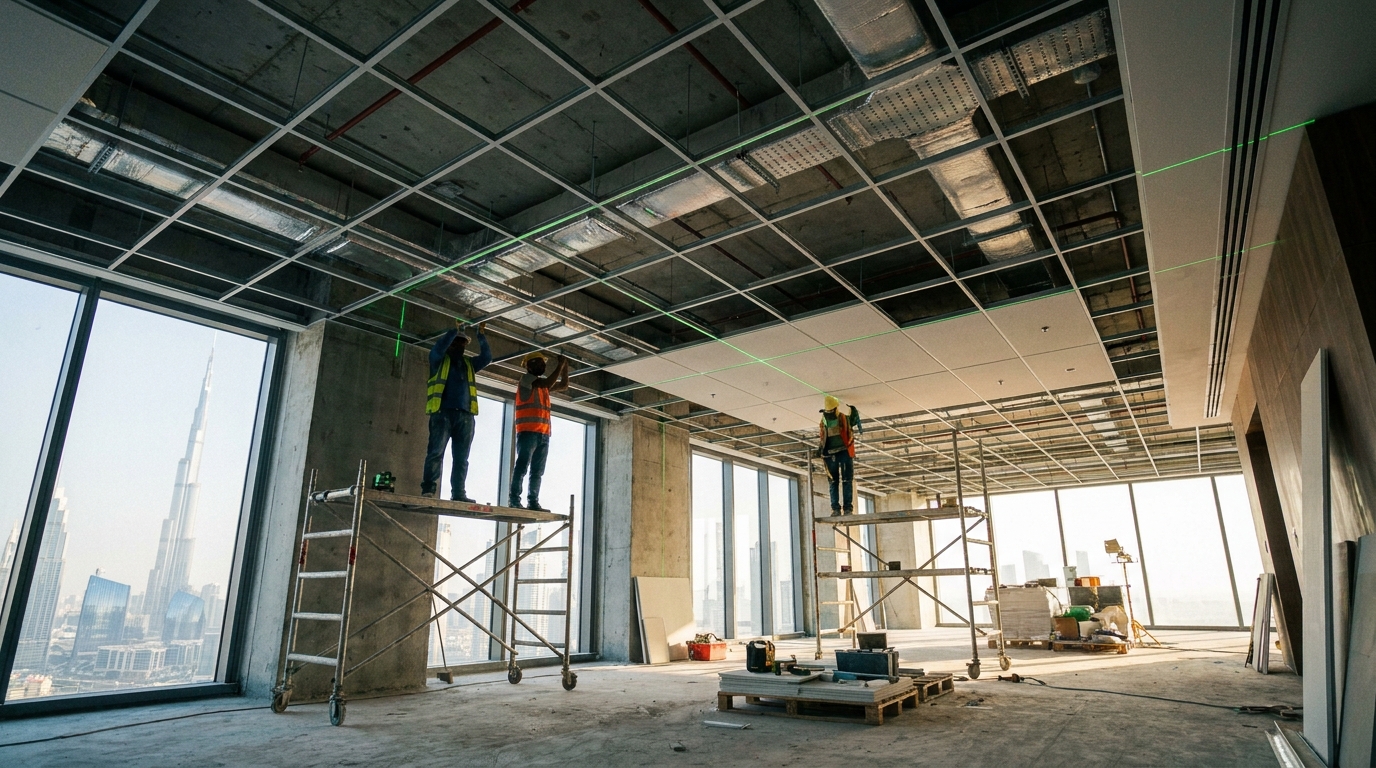
The contractor’s guide to Suspended Ceiling Installation in the UAE
Knowing how to install a suspended ceiling step by step in UAE is essential for every contractor working on commercial fit-out projects. Whether you are fitting out an office in Dubai, a retail space in Abu Dhabi, or a hotel corridor anywhere in the country, the installation method is largely the same. Whether you are fitting out an office in Dubai, a retail space in Abu Dhabi, or a hotel corridor anywhere in the country, the installation method is largely the same.
This guide walks through each stage of the process so contractors and site supervisors have a clear reference for how suspended ceiling work should be carried out.
To better understand different ceiling types, materials, and commercial applications, explore our complete guide to Ceiling Systems UAE.
If your project uses exposed or concealed grid layouts, read our detailed guide on T-Grid Ceiling Systems UAE.
What You Need Before You Start Installing a Suspended Ceiling in UAE
The structural ceiling above must be inspected to confirm it can support the hanger loads. In concrete slab construction, which is standard across UAE buildings, this is rarely an issue. However, the condition of the slab and the presence of any services running above the ceiling level need to be understood before work begins.
All mechanical, electrical, and plumbing services that will sit above or within the ceiling void should be roughed in and coordinated before the ceiling grid goes up. Going back to adjust services after the grid is installed adds time and cost.
You will also need accurate floor-to-ceiling height measurements from multiple points across the room. Floors and slabs in UAE buildings are not always perfectly level, so taking measurements at regular intervals helps you identify any variation before you set your ceiling height.
Tools and Materials Required
For a standard T-grid suspended ceiling installation, you will need the following on site: a laser level or optical level, a chalk line, a tape measure, wall angle sections, main T-runners, cross T-sections, ceiling hangers and hanger wire, ceiling tiles, a tile cutter or scoring knife, tin snips, and appropriate fixings for the slab above and the perimeter walls.
The specification for grid and tile size should come from the project drawings. The most common grid module in UAE commercial projects is 600mm x 600mm, though 600mm x 1200mm is also widely used.
For more information on choosing aluminium ceiling materials, explore “Aluminium Ceiling Tiles UAE: Complete Buyers Guide.”
Step 1: Establish the Ceiling Height and Reference Line
Using a laser level, mark the finished ceiling height on all four walls of the room. This line is the reference for everything that follows. It must be level and continuous around the entire perimeter.
For suspended ceiling installation in UAE commercial projects, the ceiling height is usually fixed by the architect or interior designer and shown on the reflected ceiling plan. Always work from the drawing, not from an assumed height.
Once the height is marked on the walls, snap a chalk line along the mark to give you a clear, visible reference for fixing the wall angle.
Step 2: Fix the Wall Angle
The wall angle is the L-shaped perimeter section that supports the outer edges of the grid. It is fixed directly to the walls at the ceiling height reference line using appropriate fixings. In UAE construction, walls are typically block or gypsum board, so the fixing type will vary. Use masonry anchors for block walls and toggle bolts or hollow wall anchors for drywall partitions.
Fix the wall angle continuously around the full perimeter of the room. Joints between lengths should be cut at 45 degrees for a neat finish at corners. The wall angle is not a structural component, but it must be fixed firmly enough to hold the grid edge in position.
Step 3: Install the Ceiling Hangers
Ceiling hangers are fixed to the structural slab above and carry the weight of the entire grid and tile system. For concrete slabs, hangers are typically fixed using shot-fired pins or drop-in anchors, depending on the slab thickness and site safety requirements.
Ceiling hanger spacing in UAE projects is typically 1200mm along the main runner direction, with rows of hangers spaced 1200mm apart across the room. This is the standard spacing for most commercial ceiling systems, though heavier ceiling types or special grid systems may require closer spacing. Always refer to the manufacturer’s specification for the system you are installing.
Hanger wire is looped through or attached to the fixed anchor and twisted back on itself to secure it. Leave enough wire length to allow for height adjustment when you come to set the grid level.
Step 4: Install the Main T-Runners
Main T-runners are the primary load-bearing members of the grid. They run in one direction across the room and are supported by the hanging wires.
Additional framing components such as support channels are equally important for ceiling durability. Read our Furring Channels UAE: Uses, Dimensions & Fixing Details guide.
To install, hook or tie the hanger wire to the slot in the main runner at the correct height, then use your laser level to confirm the runner is sitting at the exact finished ceiling height. Adjust the wire by twisting or using a hanger clip until the runner is level. Work along the full length of each runner before moving to the next one.
Main runners can be spliced end-to-end for long runs using the factory connector clips built into each length. Make sure splice joints are staggered across adjacent runners and do not line up, as this weakens the grid.
For a deeper comparison between exposed and concealed grid layouts, read our detailed guide on T-Grid Ceiling Systems UAE.
Step 5: Install the Cross T-Sections
Cross T-sections clip into the main runners at right angles to complete the grid module. For a 600mm x 600mm grid, cross tees are installed at 600mm intervals along each main runner. For a 600mm x 1200mm grid, they are installed at 1200mm intervals.
The cross tees simply push into the pre-punched slots in the main runner and lock in place. Once all cross tees are in, you will have a complete grid of rectangular or square modules ready to receive the ceiling tiles.
Check the overall grid alignment at this stage using your laser level and a straight edge. Any runners that are not level should be adjusted before the tiles go in. It is much harder to correct level issues after the tiles are installed.
Step 6: Cut and Fit Border Tiles
Border tiles are the partial tiles that fill the space between the last full grid module and the perimeter wall. Before cutting any tiles, measure the border width on all sides. Ideally, border tiles on opposite sides of the room should be the same width. If the room dimension does not divide evenly into the grid module, you can adjust the starting position of the grid to achieve balanced borders.
Cut tiles using a sharp scoring knife and a straight edge, or a tile cutter for mineral fiber tiles. Always cut from the face side to get a clean edge. Handle tiles carefully, as most ceiling tile materials used in UAE projects are fragile at the edges.
Step 7: Lay the Full Tiles
Full tiles simply drop into the grid modules from below. Lay them in from one corner of the room and work outward. Make sure all tiles are oriented the same way if the tile has a directional pattern or texture. Some mineral fiber tiles have an arrow on the back indicating the correct direction.
Check each tile as it goes in to confirm it is sitting flat in the grid. Tiles that bow or sit unevenly are usually the result of a grid that is not perfectly level, so address any grid issues before completing the tile installation.
Step 8: Install Light Fittings, Diffusers, and Access Panels
Recessed light fittings, air diffusers, sprinkler heads, and access panels all need to be cut into or dropped into the ceiling at this stage. Coordinates for these items should come from the reflected ceiling plan and the MEP coordination drawings.
If your project also requires sound control, explore our Acoustic Ceiling Systems UAE: NRC Ratings, Tile Selection & Applications.
For recessed fittings, cut the tile to the correct size before dropping it into the grid. Do not cut tiles while they are already in the grid. Access panels should be fitted in locations that allow maintenance of any services above the ceiling that may need periodic inspection.
Selecting between standard and fire-rated access solutions is important during installation. See Access Panels UAE: Fire-Rated vs Standard — When You Need Each for specification guidance.
Conclusion
A suspended ceiling installation done right in the UAE requires accurate leveling, correct hanger spacing, and proper coordination with the services above. Following each step in the right order reduces rework and gives you a finished ceiling that meets both the visual and technical requirements of the project.
GTI supplies T-grid systems, ceiling hangers, wall angles, and ceiling tiles for suspended ceiling projects across the UAE.
If you need materials for your next installation, contact our team.
Frequently Asked Questions
What is the standard ceiling hanger spacing for suspended ceiling installation in the UAE?
The standard ceiling hanger spacing in UAE commercial projects is 1200mm along the main runner, with hanger rows also spaced at 1200mm across the room. This applies to most standard T-grid systems with 600mm x 600mm or 600mm x 1200mm modules. Always check the manufacturer’s specification for the specific system you are using.
- How do I install a suspended ceiling on an uneven slab in a UAE building?
Use a laser level to establish a true horizontal reference line at the desired ceiling height. The hanger wires can be adjusted individually to bring each main runner down to the correct level regardless of slab variation.
- Can I install a suspended ceiling step by step without a contractor in Dubai?
For small residential spaces, a capable tradesperson can follow this process with the right tools. For commercial projects in Dubai and across the UAE, installation should be carried out by experienced contractors.