July 08, 2026
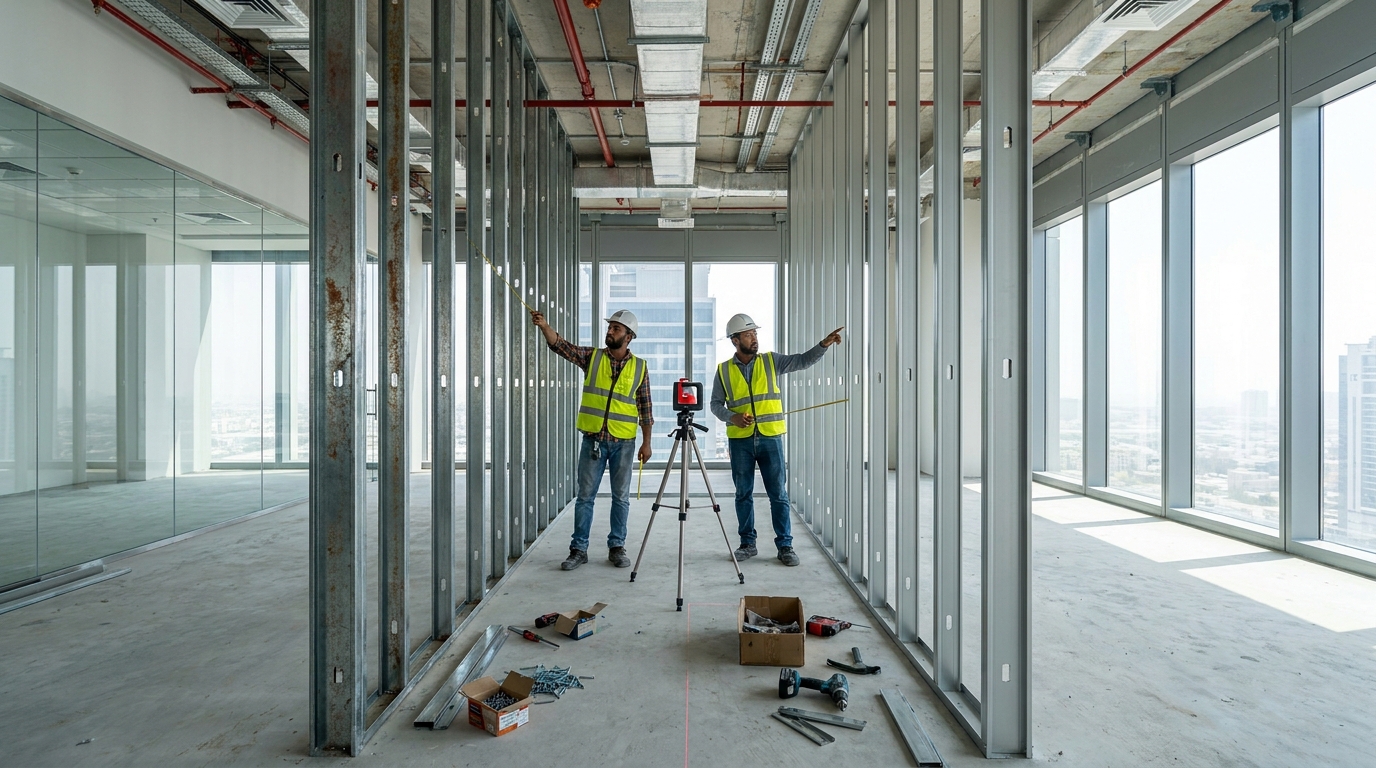
Most people specifying drywall partitions in the UAE default to GI studs. It is what contractors know, what suppliers stock, and what most project specs call for. But there is a version of this decision that most fit-out teams never fully examine. The material holding up your partition wall affects more than just the frame. It affects long-term performance, weight load on the structure, corrosion resistance, and total project cost in ways that only become obvious after the wall is up.
Here is what the difference between GI stud and aluminium stud in UAE construction actually looks like when you break it down properly.
What Each Material Actually Is
GI stands for galvanized iron, though in practice the base material is steel. The steel is coated with a layer of zinc through a galvanization process. That zinc coating is the only thing standing between the steel core and corrosion. The thickness and quality of that coating determine how long the stud holds up in conditions where moisture is a factor.
Aluminium studs are extruded from aluminium alloy. There is no coating doing the protective work. The aluminium itself is naturally corrosion-resistant because it forms a thin oxide layer on its surface when exposed to air. That layer self-repairs when scratched, which is a property galvanized steel does not share.
Both materials are used in commercial drywall framing across the UAE. They are not interchangeable on every project, and the right choice depends on factors that go beyond which one your supplier has in stock.
Strength and Structural Performance
GI steel studs are stronger than aluminium studs of equivalent dimensions. Steel has a higher tensile strength, which means a 70mm GI C stud will carry more load and resist bending better than a 70mm aluminium stud of the same gauge. For tall partitions, walls carrying heavy fixtures, or framing that needs to meet specific structural ratings, GI steel is the more capable material.
This matters on UAE commercial projects where partition heights often exceed 3 meters in open-plan offices, hotel corridors, and retail environments. A GI stud at the right gauge holds its shape under those conditions without requiring closer stud spacing to compensate for reduced rigidity.
Aluminium studs are not structurally weak. They perform adequately for standard-height, non-load-bearing interior partitions. The performance gap only becomes relevant when the partition is tall, carries significant load, or sits in a location where the framing needs to meet a structural or fire-rated assembly specification.
Choosing the right stud material is only part of a successful partition system. Our How to Install Drywall Partition Systems in UAE Commercial Buildings guide walks you through the complete installation process, including layout marking, track fixing, stud installation, gypsum board fixing, joint finishing, and fire compliance.
Corrosion Resistance: Where the Real Difference Lives
Here is where the comparison shifts. GI studs rely entirely on their zinc coating for corrosion protection. In standard interior conditions, that coating is sufficient. But the UAE is not a standard interior environment.
Coastal humidity in Abu Dhabi, Dubai, and Sharjah regularly exceeds 80 percent during summer. Condensation forms on cold surfaces in air-conditioned buildings. Moisture migrates through partition walls in spaces adjacent to bathrooms, kitchens, and external areas. In any of these conditions, a GI stud with a compromised zinc coating will begin to rust. That rust does not stay hidden inside the wall forever. It migrates through the gypsum board and shows as staining on the finished surface.
Aluminium does not rust. In high-humidity environments, locations near the coast, or spaces where moisture ingress is a known risk, an aluminium stud will outlast a GI stud without any surface treatment, coating maintenance, or replacement.
This is the part of the GI vs aluminium drywall profiles comparison most UAE specifications underweight. The initial material cost difference rarely accounts for the cost of replacing rusted framing and refinishing walls five years into a building’s life.
Weight: A Factor That Adds Up on Large Projects
Aluminium is significantly lighter than steel. A GI stud of standard dimensions weighs roughly three times more than an equivalent aluminium stud. On a small partition in a single room, this difference is trivial. On a large commercial floor plate with hundreds of linear meters of partition, the weight difference becomes meaningful.
Lighter framing reduces the cumulative dead load on the floor structure. In high-rise UAE buildings where structural engineers are working to tight load calculations, this can be a relevant consideration. It also affects handling on site. Aluminium sections are easier to cut, carry, and position, which can reduce installation time on large projects.
For metal stud comparison purposes in UAE high-rise construction, aluminium framing is sometimes specified specifically because of its weight advantage, even when GI studs would perform adequately from a strength standpoint.
Regardless of whether you choose GI or aluminium framing, proper ceiling support is equally important for long-term performance. Our Standard Hanger Spacing for Suspended Ceilings in UAE guide explains the recommended hanger spacing, T-grid requirements, and installation practices for safe suspended ceiling systems.
Fire Rating Considerations
Fire-rated drywall assemblies in the UAE must be tested and certified as complete systems. The stud material is part of that system. Most certified fire-rated partition assemblies in the UAE market are tested with GI steel studs. The higher melting point of steel means it retains its structural shape longer under fire conditions than aluminium, which softens and loses strength at lower temperatures.
For partitions that need to meet a specific fire resistance rating, whether 60 minutes, 90 minutes, or 120 minutes, check the test certificate for the assembly being specified. If the certificate specifies GI studs, substituting aluminium studs voids the rating. This is not a detail to overlook on UAE projects where Civil Defence approval depends on the certified assembly being installed exactly as tested.
In non-fire-rated locations, this distinction does not apply, and aluminium studs are a valid choice.
If your project requires certified fire-resistant wall assemblies, read How to Achieve Fire Rated Partition Walls in UAE Buildings to understand the correct materials, tested systems, and installation practices required for UAE compliance.
Cost Comparison in the UAE Market
Aluminium studs typically cost more than GI studs on a per-meter basis in the UAE market. The raw material cost of aluminium is higher than galvanized steel, and that difference carries through to the product price.
For budget-driven projects where the partition specification does not require the specific benefits of aluminium, GI studs are the more cost-effective choice. The price difference becomes harder to justify in standard dry interior locations where corrosion is not a risk, and the structural demands are within the capability of GI framing.
The calculation changes in high-humidity or coastal locations. A lower upfront cost on GI studs that corrode and require replacement within a few years is not a saving. In those environments, the higher cost of aluminium framing is an investment in the longevity of the installation.
Which Projects Should Use Each Material
GI studs are the right choice for standard interior partitions in offices, schools, retail spaces, and residential fit-outs where humidity is controlled, fire-rated assemblies are specified, or budget is the primary constraint. They cover the majority of drywall partition work across UAE commercial construction.
Aluminium studs are the right choice for coastal buildings with persistent humidity, locations adjacent to wet areas such as bathrooms and commercial kitchens, high-rise projects where cumulative structural load is being managed, and premium fit-outs where long-term performance and minimal maintenance are part of the brief.
Some projects use both. GI studs in standard interior locations and aluminium studs in high-risk areas are a practical approach that manages cost while putting the right material where the environment demands it.
Once you’ve selected the appropriate framing material for your partitions, proper ceiling integration is the next step. Follow our Suspended Ceiling Installation UAE: Step-by-Step Contractor Guide for the complete installation process, from layout planning and hanger fixing to grid assembly and ceiling tile installation.
Conclusion
The difference between GI stud and aluminium stud in UAE construction is not simply about which material is better. It is about which material is right for the specific conditions of the project.
Knowing where each one belongs is what separates a specification that performs over time from one that looks correct on paper and causes problems later.
Pairing the correct framing material with proper ceiling installation practices improves long-term performance. Read our Best Practices for Ceiling Installation in High-Humidity UAE Projects for additional guidance on moisture-resistant installations.
GTI supplies both GI and aluminium drywall profiles for commercial projects across the UAE. If you are specifying partitions for a project and need guidance on which material suits your conditions, contact our team to discuss the details and confirm availability.
Contact form.
Frequently Asked Questions
- What is the main difference between GI stud and aluminium stud in UAE drywall construction?
GI studs are made from zinc-coated steel and offer higher structural strength, while aluminium studs are naturally corrosion-resistant and significantly lighter. - Which is stronger, a GI stud or an aluminium stud for UAE commercial partitions?
GI steel studs are stronger and better suited for tall partitions, heavy fixture loads, and fire-rated assemblies in UAE commercial buildings. - Are aluminium studs more corrosion-resistant than GI studs in the UAE climate?
Yes, aluminium does not rust and outperforms GI studs in high-humidity UAE environments, particularly in coastal locations and areas adjacent to wet spaces. - Can aluminium studs be used in fire-rated partition assemblies in the UAE?
Aluminium studs are generally not suitable for certified fire-rated assemblies because most tested systems in the UAE are specified with GI steel studs, and substituting materials voids the rating. - Why are aluminium studs sometimes preferred for high-rise construction in the UAE?
Aluminium studs weigh significantly less than GI studs, reducing cumulative dead load on the structure, which can be a meaningful factor in high-rise UAE buildings with tight load calculations. - Are GI or aluminium drywall profiles more cost-effective for UAE projects?
GI studs cost less per meter and are more cost-effective for standard interior partitions, while aluminium studs offer better long-term value in high-humidity or coastal locations where GI framing is prone to corrosion. - What gauge of GI stud is typically used for commercial drywall in the UAE?
Standard commercial drywall partitions in the UAE typically use GI studs with a base metal thickness of 0.45mm to 0.55mm, with heavier gauges specified for taller walls or load-bearing applications. - Can GI and aluminium studs be used together on the same UAE project?
Yes, using GI studs in standard interior locations and aluminium studs in high-humidity or wet-adjacent areas on the same project is a practical and cost-effective approach. - How does the UAE coastal climate affect the lifespan of GI drywall studs?
Persistent coastal humidity can degrade the zinc coating on GI studs over time, leading to rust that eventually migrates through the gypsum board and stains the finished wall surface. - Where can I source both GI and aluminium drywall profiles for a commercial project in the UAE?
GTI supplies GI and aluminium drywall profiles across the UAE, and our team can advise on the right specification for your project conditions and confirm current stock availability.