May 07, 2026
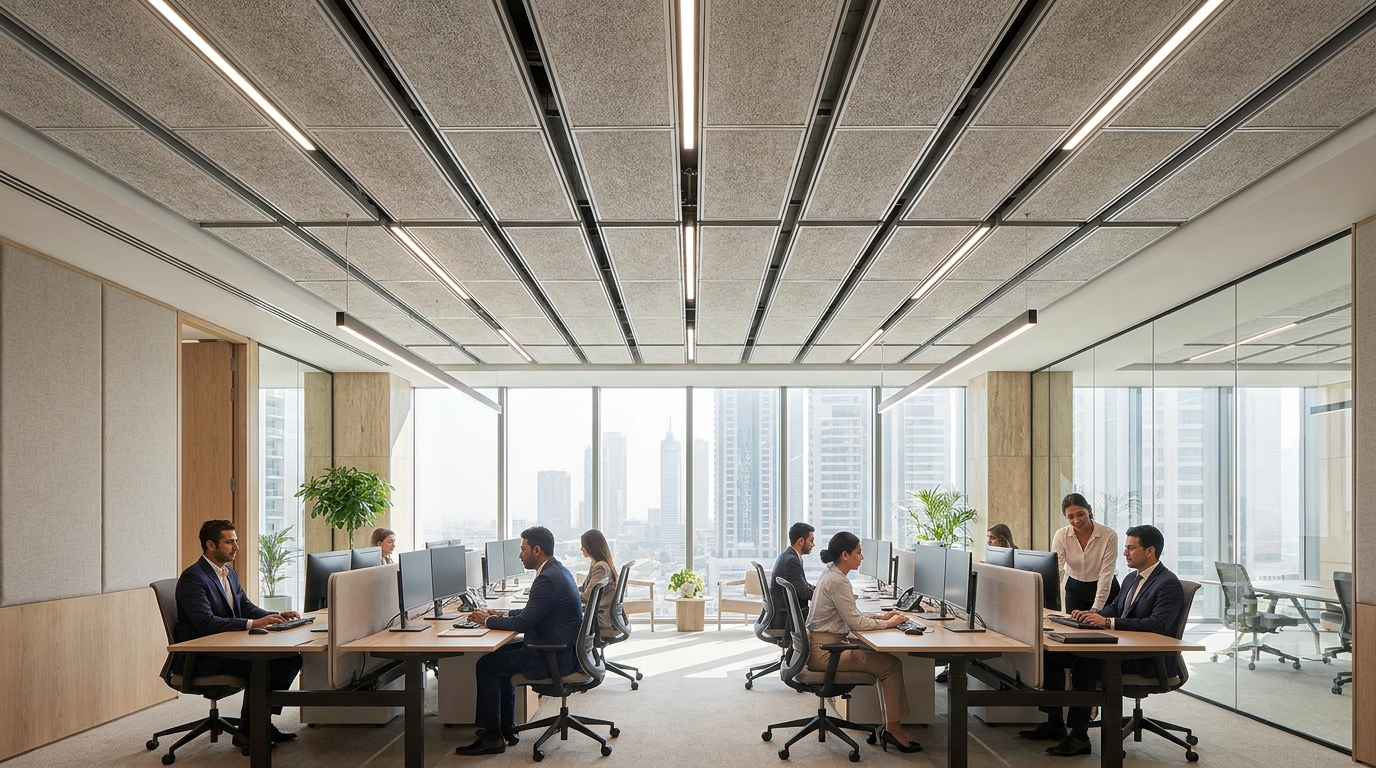
Noise is one of the most common complaints in commercial buildings, and noise is precisely what you cannot afford in a commercial building. Sound, without proper treatment, reflects off hard surfaces and makes spaces uncomfortable to work or spend time in. The solution: Acoustic Ceilings UAE
In the UAE, where large commercial and institutional projects are built at scale, specifying the right acoustic ceiling is an important part of the design process.
What Is an Acoustic Ceiling System?
An acoustic ceiling system is a suspended ceiling assembly designed to absorb sound rather than reflect it. Standard ceiling tiles, hard plaster, and concrete soffits all reflect sound into a space, which increases reverberation and makes the environment louder and less comfortable. Acoustic ceiling tiles are manufactured from materials that absorb sound energy, reducing the amount that bounces back.
The most widely used material for acoustic ceiling tiles in the UAE is mineral fibre. Mineral fibre ceiling tiles are made from a combination of mineral wool, perlite, starch, and other additives that give the tile a porous, fibrous structure. This structure traps sound waves and converts them into a small amount of heat energy, preventing them from reflecting into the room.
Acoustic ceiling systems are used alongside other acoustic treatments such as wall panels and floor finishes, but the ceiling is usually the largest single surface in a room and therefore has the greatest impact on overall acoustic performance.
For a broader overview of ceiling types and applications, explore our Ceiling Systems UAE — Complete Guide to Suspension, T-Grid & Aluminum Tiles.
Proper framing and support systems are also important for ceiling performance. Learn more in Furring Channels UAE: Uses, Dimensions & Fixing Details.
Understanding NRC Ratings
The Noise Reduction Coefficient, commonly referred to as NRC, is the standard measurement used to describe how much sound a ceiling tile absorbs. The NRC scale runs from 0 to 1. A rating of 0 means the surface absorbs no sound at all and reflects everything. A rating of 1 means the surface absorbs all sound and reflects nothing.
The NRC rating is determined through laboratory testing using standardized methods. The result reflects the average sound absorption across a range of frequencies.
It is worth understanding that NRC is an average figure. Some tiles perform better at certain frequencies than others. For spaces with very specific acoustic requirements, your acoustic consultant may look at frequency-specific data rather than relying solely on the NRC figure.
When selecting NRC-rated ceiling tiles for UAE projects, higher is generally better for spaces where noise reduction is the primary goal. However, very high NRC tiles are typically thicker, heavier, and more expensive, so the specification should be matched to the space’s actual acoustic requirements rather than defaulting to the highest available rating.
Mineral Fibre Ceiling Tiles: The Most Common Acoustic Solution
Mineral fibre ceiling UAE projects specify most frequently combines good acoustic performance with practical benefits that suit the demands of commercial construction. These tiles are lightweight, easy to handle and cut, compatible with standard T-grid systems, and available in a range of surface textures and finishes.
Thicker tiles generally offer better acoustic absorption and are also better at reducing sound transmission through the ceiling into the floor above, though this depends on the specific product.
Most mineral fibre ceiling tiles are finished in white and have a factory-applied surface coating that can be repainted if needed. Some tiles are manufactured with a higher-reflectance surface to improve light distribution in the space, thereby reducing the number of light fittings required and lowering energy consumption.
Sound Absorbing Ceiling Options Beyond Mineral Fibre
While mineral fibre is the standard choice for sound-absorbing ceiling applications in the UAE, other materials are used where specific performance or aesthetic requirements apply.
Perforated metal ceiling tiles, including the aluminium perforated tiles discussed in commercial ceiling specifications, can provide acoustic performance when an acoustic fleece or mineral wool backing is installed above them in the ceiling void. The tile itself does not absorb sound, but the combination of the perforated face and the absorber above works as an effective acoustic system. These are often chosen where a more durable or visually distinctive ceiling is required alongside acoustic performance.
You can learn more about perforated aluminium ceiling options, finishes, and specifications in our Aluminium Ceiling Tiles UAE: Complete Buyers Guide.
Glass wool ceiling tiles are another option. Similar in performance to mineral fibre, glass wool tiles offer high NRC ratings and are used in applications where humidity resistance is important, such as in swimming pool facilities or food production environments.
Fabric-wrapped acoustic panels are sometimes incorporated into ceiling designs as feature elements, particularly in high-specification office interiors, boardrooms, and hospitality projects. These are not standard lay-in tiles but rather bespoke panels that are designed as part of the interior scheme.
Acoustic Ceiling for Office Spaces in Dubai
The acoustic ceilings for office projects in Dubai have become increasingly important as open-plan working environments have become the norm. In a typical open-plan office, conversations, phone calls, keyboard noise, and background mechanical sound all combine to create a high ambient noise level that reduces concentration and productivity.
A well-specified acoustic ceiling in an office environment typically targets a reverberation time that keeps speech intelligible without allowing sound to carry too far across the floor plate. For open-plan offices, an NRC rating of 0.70 or above is generally recommended. Private offices and meeting rooms may have lower acoustic demands from the ceiling if wall and floor treatments are also being used.
Beyond NRC, office acoustic ceiling specifications in Dubai and across the UAE often include requirements for ceiling attenuation class, which measures how much sound the ceiling system reduces between adjacent spaces that share the same ceiling void. This is particularly relevant in open-plan offices with partial-height partitions, where sound travels over the top of the partition and through the ceiling void to neighboring spaces.
Applications Across Different Building Types
Acoustic ceiling systems are used across a wide range of building types in the UAE, each with different performance requirements.
In healthcare facilities, acoustic ceilings help reduce noise levels in wards, consultation rooms, and waiting areas. Lower noise levels in healthcare settings are associated with better patient outcomes and reduced staff stress. In these environments, ceiling tiles also need to meet hygiene requirements, so products with smooth, cleanable surfaces and resistance to moisture and mold are specified alongside acoustic performance.
In education buildings, acoustic performance in classrooms directly affects how well students can hear and understand their teachers. UAE schools and universities increasingly specify acoustic ceilings as a standard part of the fit-out rather than an optional upgrade. Recommended NRC values for classrooms typically start at 0.70.
In hotels and hospitality projects, acoustic ceilings are used in corridors, lobbies, restaurants, and conference facilities. The visual finish of the tile is as important as the acoustic performance in these settings, so products that combine a refined appearance with good NRC ratings are preferred.
In retail environments, acoustic treatment is often used in food courts, cinema foyers, and entertainment areas where large numbers of people generate high noise levels.
What to Consider When Specifying an Acoustic Ceiling in the UAE
When selecting an acoustic ceiling system for a UAE project, start with the acoustic performance target for the space. If an acoustic consultant is involved, they will provide NRC targets and possibly frequency-specific requirements. If not, refer to the building type guidelines above as a starting point.
Consider the ceiling height and grid system already specified or in use. Most acoustic mineral fibre tiles are designed for standard T-grid systems, so compatibility is rarely an issue. However, if a concealed grid or a specific edge profile is required, confirm product availability before finalizing the specification.
You can also explore our T-Grid Ceiling Systems UAE: Exposed vs Concealed — Contractor Guide to compare grid systems for different project requirements.
Need installation guidance? Read our Suspended Ceiling Installation UAE: Step-by-Step Contractor Guide to understand the complete process.
Check humidity resistance ratings for spaces that may be exposed to moisture. Standard mineral fibre tiles are not suitable for wet areas. Many manufacturers produce tiles with enhanced humidity resistance for use in areas where moisture levels may be higher than normal.
Finally, confirm lead times and stock availability in the UAE before committing to a product. Standard white mineral fibre tiles in 600mm x 600mm are widely stocked. Specialty products, high NRC tiles, or specific edge profiles may need to be ordered in advance.
Acoustic ceiling layouts should also include properly specified Access Panels UAE: Fire-Rated vs Standard — When You Need Each to maintain service accessibility while preserving acoustic performance.
Conclusion
Acoustic ceiling systems play a practical role in making commercial spaces in the UAE more comfortable and functional. Understanding NRC ratings, knowing the difference between material types, and matching the specification to the actual demands of the space will result in a ceiling that performs as intended and lasts the life of the project.
GTI supplies acoustic ceiling tiles and mineral fibre ceiling systems across the UAE. Contact us to discuss your project and check current stock availability.
Frequently Asked Questions
What does NRC mean for acoustic ceiling tiles in UAE projects?
NRC stands for Noise Reduction Coefficient. It measures how much sound a ceiling tile absorbs on a scale from 0 to 1. A higher NRC means more sound absorption.
What is the best acoustic ceiling for an office in Dubai?
For open-plan offices in Dubai, mineral fibre ceiling tiles with an NRC rating of 0.70 or above are generally recommended.
Are mineral fibre ceiling tiles suitable for humid environments in the UAE?
Standard mineral fibre ceiling tiles are designed for normal interior conditions. For areas with higher humidity, such as kitchens, changing rooms, or spaces near external openings, humidity-resistant mineral fibre tiles should be specified.
How do sound-absorbing ceiling tiles differ from standard ceiling tiles in the UAE?
Standard ceiling tiles are primarily a visual finish and do little to reduce noise in a space. Sound-absorbing ceiling tiles are manufactured from porous materials such as mineral fibre that trap sound energy rather than reflecting it.