July 02, 2026
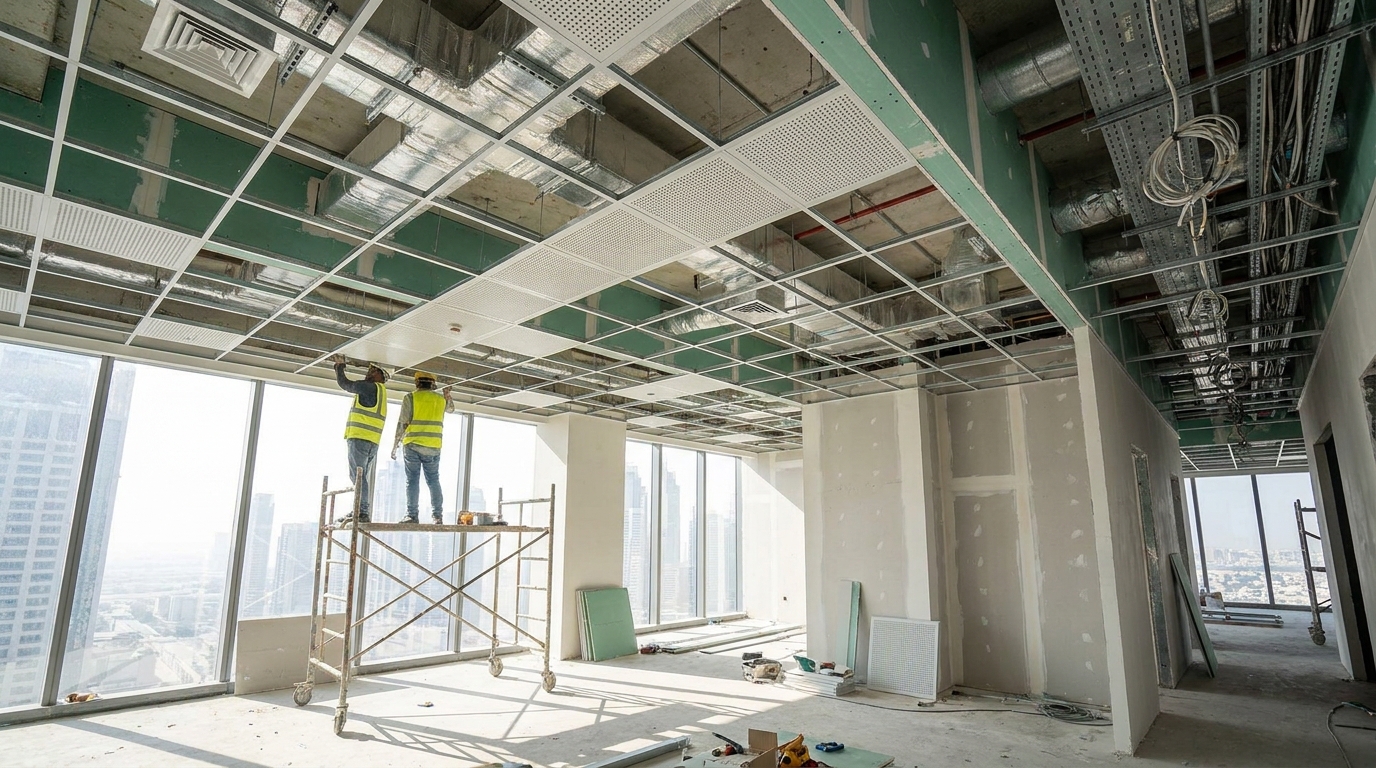
The UAE climate creates conditions that most building material specifications were not originally designed for. Coastal humidity, temperature swings between air-conditioned interiors and hot exteriors, and the occasional sandstorm all put pressure on materials that perform perfectly well in more temperate climates.
For ceiling and drywall installations, humidity is the single most significant environmental factor to understand and account for before, during, and after installation.
The UAE Climate and What It Means for Interior Installations
The UAE sits in a hot desert climate with high coastal humidity, particularly in Abu Dhabi, Dubai, Sharjah, and other emirates along the Arabian Gulf. Relative humidity levels along the coast regularly exceed 80 percent during summer months, and condensation on building surfaces is common in spaces where air conditioning creates a significant temperature difference between interior air and wall or ceiling surfaces.
Inland areas such as Al Ain experience lower humidity but more extreme temperature variation. Both conditions, high coastal humidity and inland temperature swings, create stress on interior building materials that need to be accounted for in the specification.
How Humidity Damages Standard Gypsum Board
Standard gypsum board is made from a gypsum plaster core sandwiched between two layers of paper facing. The paper facing and the gypsum core are both vulnerable to moisture. When exposed to high humidity or direct moisture contact, standard gypsum board absorbs water into both the core and the facing.
The consequences of moisture absorption in standard gypsum board are progressive. In the early stages, the board softens and loses some of its rigidity. Screws begin to pull through the face more easily. The surface may develop bubbling or separation between the paper facing and the gypsum core. In more advanced cases, the core can crumble, the board sags visibly, and mold growth begins on the paper facing.
In a UAE ceiling installation, sagging gypsum board is one of the most visible failure modes. A ceiling that was flat and level at installation can develop noticeable bowing within months if the board specification was wrong for the environment or if condensation was allowed to form repeatedly on the ceiling surface.
How Humidity Affects Ceiling Tiles
Standard mineral fibre ceiling tiles are similarly vulnerable to moisture. These tiles are manufactured from a porous, fibrous material that absorbs airborne humidity over time. In high-humidity environments, standard mineral fibre tiles can sag, warp, and develop surface staining. The tile loses its flat profile and begins to bow downward in the center of the grid module, which creates an uneven ceiling appearance that is difficult to correct without replacing the affected tiles.
Surface staining on mineral fibre tiles in humid UAE environments is often caused by a combination of moisture absorption and dust settlement on the surface. Once the tile surface has been wetted and dried repeatedly, the staining becomes permanent, and the tile needs to be replaced.
Aluminium ceiling tiles do not absorb moisture and are not affected by humidity in the same way. This is one of the reasons aluminium tiles are preferred in areas of UAE commercial buildings where humidity levels are higher than normal.
To compare the best humidity-resistant ceiling materials for different applications, read our guide on Which Ceiling Tiles Are Best for High Humidity Areas in UAE.
UAE Climate Ceiling Problems: Where They Occur Most Often
Certain locations within UAE buildings are more prone to humidity-related ceiling problems than others. Understanding where these problem areas are helps specify the right materials before installation rather than replacing failed materials after the fact.
Spaces directly below roof level are exposed to heat gain from above and air conditioning from below, which creates conditions for condensation on the ceiling structure. Car park entry areas, loading docks, and spaces with large openings to the exterior experience frequent changes in humidity as outdoor air enters the building.
Toilets, pantries, and staff kitchen areas generate moisture directly from use. Spaces above or adjacent to swimming pools or water features in hospitality buildings have consistently high humidity levels. Server rooms with intensive cooling can create condensation on surrounding walls and ceilings if the vapor barrier is not correctly detailed.
In all of these locations, standard gypsum board and standard mineral fibre tiles are the wrong specification regardless of the overall quality of the fit-out.
For office environments, selecting the right ceiling system is equally important. See What Type of Ceiling System is Best for Offices in Abu Dhabi & Dubai.
Healthcare facilities also require moisture-resistant ceiling systems that support hygiene and infection control. Learn more in Best Ceiling System for Hospitals and Healthcare Facilities in UAE.
Moisture-Resistant Ceiling Systems: UAE Projects Should Specify
The UAE market offers moisture-resistant ceiling systems designed specifically for environments where standard products would fail. Specifying these products in appropriate locations is straightforward once the risk areas are identified.
Moisture-resistant gypsum board, commonly referred to as green board due to its typical color coding, is manufactured with a water-repellent core and a moisture-resistant facing. It is designed for use in areas with elevated humidity and performs significantly better than standard board in these conditions. For UAE ceiling installations in bathrooms, kitchens, and other wet-area adjacent spaces, moisture-resistant board should be the baseline specification rather than an upgrade.
Humidity-resistant mineral fibre ceiling tiles are produced with additives that prevent the tile from absorbing moisture and sagging. These tiles are tested and rated for performance in high-humidity conditions and are the correct specification for any ceiling tile installation in a UAE location where humidity is a known factor.
Aluminium ceiling tiles are the most robust solution for areas with persistent high humidity. They do not absorb moisture, do not sag, and do not develop surface staining from humidity exposure. In locations such as car park entry zones, covered external areas, and commercial kitchen ceilings, aluminium tiles are often the only practical ceiling tile option.
Calcium silicate boards are another option for high-humidity ceiling and wall applications. These boards are manufactured from calcium silicate rather than gypsum and have inherent moisture and mold resistance. They are denser and heavier than standard gypsum board but perform reliably in conditions where gypsum products would fail.
If you’re also deciding between suspended ceiling systems, read What Is the Difference Between Exposed and Concealed T-Grid Ceiling in UAE before finalizing your specification.
The Role of Vapor Barriers and Insulation
Specifying the right board or tile is necessary but not always sufficient on its own. In UAE buildings where condensation is a risk, a vapor barrier installed on the warm side of the ceiling or wall assembly prevents moisture-laden air from reaching the cold surface where it would condense.
Without a correctly installed vapor barrier, even moisture-resistant boards and tiles can be overwhelmed by persistent condensation. The vapor barrier works alongside the material specification to manage moisture at the assembly level rather than relying entirely on the board or tile to resist it.
Insulation also plays a role. Adequate thermal insulation in the ceiling assembly reduces the temperature differential between the interior surface and the air above, lowering the risk of condensation forming on the ceiling board or tile.
Installation Conditions Matter as Much as Material Specification
How does humidity affect drywall ceiling installation in UAE construction sites? Beyond the long-term performance of the finished installation, humidity affects the installation process itself. Gypsum board delivered to a site and stored in humid conditions before installation can absorb moisture before it is even fixed in place. The board that goes up wet will dry out and shrink, opening joints and causing cracking at taped seams.
On UAE construction sites during summer months, storing gypsum board and ceiling tiles off the ground, away from external openings, and ideally in a conditioned or at least shaded environment reduces moisture uptake before installation. Jointing compounds applied in high humidity take longer to dry and can crack if the drying conditions are inconsistent.
Running the building’s air conditioning system during the final stages of installation, if it is available, significantly improves the installation conditions for gypsum board work and reduces the risk of post-installation shrinkage cracking.
Humidity is just one factor when selecting a ceiling system. Our guide on How to Choose the Right Ceiling System for a Commercial Project in UAE covers acoustics, fire ratings, maintenance, and material selection for commercial projects.
Conclusion
Humidity is one of the most consequential factors in ceiling and drywall installation across the UAE. Standard products specified without accounting for the local climate lead to sagging tiles, warping board, mold growth, and premature replacement. Matching the material specification to the humidity risk of each location, installing vapor barriers where condensation is a risk, and managing site storage conditions are all part of delivering an installation that performs as intended over the life of the building.
GTI supplies moisture-resistant gypsum boards, humidity-resistant ceiling tiles, aluminium ceiling systems, and calcium silicate boards for UAE projects where standard products are not sufficient.
Contact our team to discuss the right specification for your project location and environmental conditions.
Frequently Asked Questions
- How does humidity affect drywall ceiling installation in UAE buildings? High humidity causes standard gypsum board to absorb moisture, leading to softening, surface deterioration, mold growth, and visible sagging in ceiling installations across the UAE.
- What are the most common UAE climate ceiling problems caused by moisture? The most common problems are sagging mineral fibre tiles, warping gypsum board, mold growth on paper-faced boards, and surface staining on ceiling tiles in areas with persistent high humidity.
- What is the best moisture-resistant ceiling system for UAE commercial projects? Aluminium ceiling tiles are the most durable moisture-resistant option, while humidity-resistant mineral fibre tiles and moisture-resistant gypsum board are suitable for most elevated-humidity interior locations.
- Should I use moisture-resistant gypsum board in all UAE ceiling installations? Moisture-resistant board should be specified in any location with elevated humidity risk, including bathrooms, kitchens, spaces below roof level, and areas adjacent to external openings, but standard board is acceptable in normal interior conditions.
- Do aluminium ceiling tiles perform better than mineral fibre tiles in the UAE humidity? Yes, aluminium tiles do not absorb moisture and are unaffected by humidity, making them the more reliable choice in persistently humid locations compared to even humidity-resistant mineral fibre tiles.
- What is a vapor barrier, and why does it matter for UAE ceiling installations? A vapor barrier is a moisture-resistant membrane installed on the warm side of a ceiling or wall assembly to prevent humid air from reaching cold surfaces where it would condense and damage the materials behind.
- Can standard mineral fibre ceiling tiles be used in UAE coastal buildings? Standard mineral fibre tiles are not recommended for coastal UAE locations with consistently high humidity, as they will absorb airborne moisture over time and begin to sag and stain.
- How should gypsum board be stored on UAE construction sites to prevent moisture damage? The board should be stored off the ground, away from external openings, in a shaded or conditioned space, and kept wrapped until it is ready to be installed.
- Does running air conditioning during installation help with drywall quality in the UAE? Yes, running air conditioning during the final installation stages reduces ambient humidity on site, improves drying conditions for jointing compounds, and lowers the risk of post-installation shrinkage cracking.
- What ceiling materials should be avoided in UAE bathrooms and commercial kitchens? Standard gypsum board and standard mineral fibre tiles should not be used in UAE bathrooms or commercial kitchens, as the moisture generated in these spaces will cause rapid deterioration of both materials.